I am the Rector of two of the three churches in the world dedicated to St Hybald, one of which (Hibaldstow) contains his remains. This blog is mainly for my monthly parish magazine articles.

Disclaimer: Calling myself "Hybald's Rector" does not imply that St Hybald would agree with everything I say!!

Showing posts with label Christmas. Show all posts

Wednesday, 3 December 2025

Be far more retro!

Here's my article for December:

Photo by Annie Spratt on Unsplash


Christmas is often a time when we indulge in nostalgia, recalling happy memories of past Christmases with family, friends and loved ones.    And perhaps trying to re-create those memories by carrying on family traditions, listening to the classic Christmas songs, and putting up the same decorations in the same place.  A visit to church for a carol service might also be part of an attempt to re-live those treasured times.  Because nostalgia plays such a big rĂ´le in our experience of Christmas, it is a common theme in Christmas advertising, where companies try to persuade us that buying their products will help us replicate the feelings we cherish.

Fr. Philip Hall, the parish priest of the Antiochian Orthodox Christian Church of All Saints of Lincolnshire, Lincoln, wrote in his November newsletter of a current advert trying to persuade us that the “magic of Christmas” is to be found in retro-style decorations. However, he says, “we need to be far more retro”!  If we want the 'magic' of Christmas we need to go back not to our childhood, or even to the idealised Victorian Christmas, but we need to go back 2,000 years to remember the spiritual roots of our celebrations.

One reason we often look back to a 'golden time' of Christmases past is that those celebrations, especially when we were children, were responsibility-free – all we had to do was enjoy the presents, the food, the parties, the people.  We didn't have to worry about arranging them or paying for them; they just magically appeared!  As adults, the necessary but mundane, behind-the-scenes preparations often take the lustre off our enjoyment of the very experiences we work so hard to create.  No wonder we want to feel Christmas like a child again!

What we long for is a re-enchantment of Christmas, and not just of Christmas but of the whole of our lives: we wish it could be Christmas everyday, as long as it's the 'magical' Christmas we remember, not the pressurised adult version!  Fr Philip is right that if we want to re-enchant Christmas and our lives we need to be far more retro and go back to the source: Christmas is 'magical', not in the sense of wizards but in that it reveals to us another realm of reality beyond the mundane, natural universe; it reveals the super-natural to us.

Religions might affirm that the supernatural exists, or even that we might enter the supernatural realm after death, but Christmas tells us something far more wonderful; that the supernatural realm entered our natural realm as the baby Jesus, so that the supernatural could dwell amongst us, and our mundane world could be re-enchanted.  A re-enchanted world is one that has a meaning and a purpose; a naturalistic world, one that exists through blind chance and the laws of physics, has no ultimate meaning or purpose and is dis-enchanted.   Jesus comes to offer us life in all its re-enchanted fullness (John 10:10) that as we live in relationship with him, he lives in us. So if you feel discontented with the mundane, why not come to church and be far more retro?


Tuesday, 3 December 2024

Reindeer names and nicknames

Here's my December article:


You know Dasher and Dancer, and Prancer and Vixen, Comet and Cupid, and Donner and Blitzen, and you will also know Rudolph. But do you also know about Flossie and Glossie, and Racer and Pacer, Reckless and Speckless, Fearless and Peerless, and Ready and Steady? In 1823, the poem “A Visit from St Nicholas” made famous the first set of reindeer (minus Rudolph who wasn't created until 1939.) Almost eighty years later, L. Frank Baum (who wrote “The Wizard of Oz”) wrote a book called “The Life and Adventures of Santa Claus” and gave the second set as Santa's reindeer. We don't know why he decided to use different names, but it shows that Christmas traditions are not set in stone!

The reindeer names are probably meant to tell us something of the character of each of them, even if their characters aren't developed in the stories, and this is a common feature of story-telling. It also happens in real life as we name pets and even give each other nicknames based on character or skills.

In church there are many Christmas traditions, and we hear familiar readings from the Bible telling of the preparation for Jesus in the Old Testament and the accounts of the events around his birth. Some of these readings give nicknames for Jesus that tell us important things about who he is and what he came to do.

Perhaps the most famous is the titles Jesus is given in Isaiah's prophecy in Isaiah 9:6 “For to us a child is born, to us a son is given, and the government will be on his shoulders. And he will be called Wonderful Counsellor, Mighty God, Everlasting Father, Prince of Peace.”

'Wonderful Counsellor' tells us that Jesus is wonderful in the sense that he arouses in us a sense of wonder and awe and marvel. As we approach Christmas, familiarity blind us to the amazing events surrounding Jesus' birth, like the angels, the star and the virgin birth itself, so we need to recover our wonder at the very coming of Jesus, how “...within a manger lies / he who built the starry skies.” As Counsellor he imparts wisdom and truth to us, not as just one more voice among many but as the one who has the words of eternal life (John 6:68), who is Wisdom (1 Corinthians 1:24) and Truth (John 14:6).

The name 'Mighty God' has overtones of powerfulness and strength particularly in battle, and this reminds us that Jesus didn't just come to do miraculous deeds, or give amazing teachings, but that he came to fight the spiritual enemies of sin and death. To call Jesus “Everlasting Father” reminds us of his eternal, divine nature and also that his character is father-like. His government will not rule by fear and oppression but will be characterised by peace, justice and righteousness, and he is also the 'Father' of our redemption (Hebrews 2:10-13 and 12:2).

Jesus' title of Prince of Peace is probably one of his best known and reminds us that through his death and resurrection he brings peace and reconciliation between humanity and God (Romans 5:1) and therefore also the possibility of peace between people.

But there are two more names that sum up what Christmas is all about: Gabriel tells Joseph “to give him the name Jesus, [which means the Lord saves] because he will save his people from their sins.” And Matthew tells us “All this took place to fulfill what the Lord had said through the prophet: 'The virgin will conceive and give birth to a son, and they will call him Immanuel' (which means 'God with us')” (Matthew 1:21-23). So this Christmas why not find out more about the God who comes to us as a baby to save us from our sins?

Photo by Norman Tsui on Unsplash

Thursday, 14 December 2023

The Snowman melts

Here's my talk for this year's Memorial Service, the reading was 1 Corinthians 15:12-26:


Christmas is a time that's full of traditions. Even these days, when we all get our news and entertainment from a myriad of different sources, the Christmas traditions of repeated TV shows and film have the power to bring us together. One of these staples of Christmas is The Snowman.

A few years ago, I realised my youngest child had never seen this film, so I decided to sit all the children down to watch it on Christmas Day. The older children weren't that interested in it, but reluctantly sat down too. As you know the boy, James, creates the snowman, which magically comes to life – at which point one of the older children turned to the youngest and said “He melts at the end!”

That put a bit of a dampener on it! But in some ways it was a very insightful comment on the film, because The Snowman is not a film about the joy and magic of Christmas, it is actually a film about death. Raymond Briggs, who created the story, said that the story was designed to introduce children to the concept of mortality.

Briggs himself struggled with his grief. He was an only child and his parents died from cancer just nine months apart in 1971, and his wife died from leukaemia just two years later. Briggs was still grieving when he created The Snowman a few years after. He is quoted as saying “The snowman melts, my parents died, animals die, flowers die. Everything does. There’s nothing particularly gloomy about it. It’s a fact of life.”

We all have different journeys of grief, but part of that journey must involve coming to terms with the reality and finality of death. The person we loved is no longer with us, they have gone and we are parted from them. At the end of the film, the snowman has melted and all James is left with is the scarf and his memories.

The same is true for us, when a loved one dies, all we are left with is some physical objects that are linked with them and our memories of them. Today we have another opportunity to recall those memories we have.

However, although memories are good, it is not helpful to say that our loved ones live on in our memories – that places an incredible and impossible burden on us. Our loved ones do not die if we forget to think about them because they are dead already. Remembering them is good, but not remembering them is OK too.

The Snowman ends with James kneeling in the snow, holding the scarf, distraught at the death of his friend. There is no happy ending. Death has the final say.

In his letter to the Corinthian church, the apostle Paul says “If only for this life we have hope in Christ, we are of all people most to be pitied.” Christians believe in the resurrection, in the possibility of life after death, but if there is no such thing as life after death, if death does indeed have the final say, then Christians are fooling themselves and are in a worse position than those who don't believe in an afterlife at all.

But, Paul says, Jesus has been raised from the dead and those who belong to him, those who have a true and lively faith in him, will also share in that resurrected eternal life. And when Jesus returns, he will reign and destroy death itself. Death doesn't have the final say. Jesus does.

In The Snowman, Raymond Briggs presents us with the truth that death is a reality and has a finality to it. But this is only a partial truth. One of the reasons we celebrate Jesus' birth is because through his life, death and resurrection he defeats the hold that death has on us. Without him, death wins and we are lost forever. With him, life wins and those who belong to Jesus will live forever.


Photo by Gemma Evans on Unsplash

Friday, 8 December 2023

The night before Christmas

Here's my article for the December and January magazines:


Our Christmas traditions and celebrations come from many different places and cultures, but perhaps one of the greatest influences on our perception of Christmas is the 1823 poem “A Visit from St. Nicholas” by Clement Clarke Moore, more commonly known by its first line: “ 'Twas the night before Christmas”. In this poem Moore describes St Nicholas, names his reindeer, and has him coming down the chimney to deliver presents. This eventually became the standard legend of Santa Claus, replacing many of the local variations on the theme of Christmas visitors. However, we should probably have also noted Moore's warnings in his follow-up poem “The Night after Christmas” which describes the children being visited by their doctor after having too many of the treats delivered by Santa!!

The phrase “The night before Christmas” evokes all those feelings of anticipation for the joy of Christmas, but in his book “The Air We Breathe”, Glen Scrivener uses it in a different way. His book describes how the Christian message underpins the way we view life and the values we hold, noting particularly the contrast with the values of the society into which the Christian message was first preached. He describes that culture as the night before Christmas.

The metaphor of night is very apt as it reminds us that the values that we think of as obvious, natural and universal (Glen highlights the values of equality, compassion, consent, enlightenment, science, freedom and progress) are “profoundly alien” to the culture, assumptions, beliefs, intuitions and ideals of the pre-Christian and non-Christian world. It's not that the ancient world was a little bit worse than our Western world, rather it is as different to us as night is to day. But we've spent so long in the light that we can't imagine what night would look like and therefore can't believe it ever existed.

Glen reminds us that Christmas, Jesus' birth, marked the end of that night. Some claim that the celebration of Christmas is pagan in origin, pointing to similarities in celebrations and even the concept of a god coming to earth. However,even before he could walk or talk, Jesus' birth is in stark contrast to the myths around at the time. In those myths, humans are created to be slaves or entertainment for the gods, and when a god comes to earth it is usually to kill, rape and destroy – and all should fear. But when Jesus is born the Almighty God becomes human (John 1:1-14) and the world is told to rejoice (Luke 2:8-20). Humans have dignity because they are made in the image of God and because God chose to become human. And from that good news flows all the values that form the 'day' we live in.

Jesus' birth has influenced and shaped our world more than Moore's poem has influenced our celebration of Christmas. This Christmas why not find out more about the Jesus who brings the morning which shatters the night that we had before Christmas?


Tuesday, 13 December 2022

Do we know it's Christmas?

Here's my December article:


By the time you read this article you may already be sick of hearing Christmas songs wherever you go. Just as 'The Chicken Song' parodied summer songs, Peter Kay, as 'Geraldine McQueen', lovingly parodied Christmas songs in 'Once Upon a Christmas Song' singing “It's getting in your head / And if you're not singing it all night, / You'd be telling a lie, / You'll be singing this over and over, and over again.”

Everyone has their own favourite Christmas song (and usually at least one that they hate!) but the chances are that at some point you'll hear at least one version of “Do they know it's Christmas?” It was Christmas Number 1 in 1984 by Band Aid and spawned three cover versions which also went to Number 1. The original was written to raise money for Ethiopia in the wake of the famine there, and is the best selling Christmas song of all time, selling 3.82 million units. This is despite it being generally recognised as having little artistic merit as a song, including by its writers - although as Midge Ure wrote in his autobiography “It was all about generating money... The song didn't matter: the song was secondary, almost irrelevant.”

But to some the song does matter. It has been accused of a patronising view of Western 'civilisations' coming to the rescue of poor Africans. It also is wildly inaccurate, claiming “there won't be snow in Africa this Christmas time” (not even on Mount Kilimanjaro or the Atlas mountains?), and that it's a place “where nothing ever grows”(!) and “no rain or rivers flow.” Of course, as the cause of the song was a famine, this might be forgiveable hyperbole, but as the song has been reissued and this line kept it perpetuates a misleading picture of Africa, which in fact has two of the top ten wettest places in the world and two of the top ten longest rivers in the world (including the longest!).

Bob Geldof responded to such analysis of the inaccuracies in the lyrics by saying that its just a pop song not a doctoral thesis. However, the most problematic aspect of the song is the view it has of what Christmas actually means.

It suggest that the reason that Africans might not know it's Christmas is because they won't have parties, snow, presents and food and drink – and this says a lot about what we think Christmas is all about. As African Christians appear in the New Testament, and more Christians live in Africa than any other continent it is unlikely that they don't know it's Christmas! More than that, each year the charity Open Doors published a 'World Watch List' (an annual ranking of the 50 countries where Christians face the most extreme persecution) and five of the top ten worst countries are in Africa. So not only do Africans know what Christmas is, they are prepared to suffer for their belief in the Jesus whose birth is celebrated at Christmas.

A Somalian woman who was tortured for her faith said “Previously I didn’t have happiness, but now I have joy… I know that until I came to know Jesus, I knew nothing at all.” If this time of year is just about presents and parties, perhaps it's us who don't know it's Christmas.

Wednesday, 8 December 2021

Black Friday or White Christmas?

My article for the December and January magazines:


Christmas is a time for traditions: the food, the music, the decorations (and complaining about how early they go up!), the parties, the church services and of course it wouldn't be Christmas without the cries of “It's all too commercialised!” We may lament that children are no longer content with Christmas presents consisting of shed-built wooden toys, an apple, an orange and some nuts, but I suspect that none of us would actually want it to be like that again. However it is true that in all the focus on the extravagance of presents or celebrations, the true reason for Christmas gets lost.

Nothing exemplifies this more than 'Black Friday'. Originally a term to describe the crowds of U.S. citizens starting their Christmas shopping on the day after Thanksgiving, it became an opportunity for retailers to offer big sales. This trend has recently (at least pre-pandemic) become more popular outside the U.S.A. and has been adopted by many retailers in this country. It's not just the consumerism of Black Friday that is a problem, but also the behaviour that it stirs up – there are often stories about injuries and even deaths caused by crowding and fighting over hugely discounted and desirable products. Fighting and injuries are also a feature of the other UK Black Friday – the nickname used by the emergency services for the Friday before Christmas due to its popularity as a night for Christmas parties. So, whether it's about presents or partying, for many people Christmas is defined by Black Friday.

Although Black Friday, in either use, is almost the opposite of the meaning of Christmas as a time of altruism and peace, it does show us why Christmas was necessary. Black Friday reminds us how as humans we can easily take something good, for example giving presents and celebrating with family and friends, and turn it into something bad. This is what the Christian faith calls 'Original Sin' – the innate tendency of humans to choose selfishness and our own interests over the interests of others, and to reject God's authority over us. Black Friday shows that Christmas is necessary because Christmas is defined not by Black Friday but by Good Friday.

The consequence of Original Sin is that we are unable, and ultimately unwilling, to do anything about our sinfulness and so we need a Saviour. This Saviour had to be human so that he could identify with us, suffer in our place and sympathize with us in our weakness. But he also had to be divine to pay off the infinite wrath of God incurred by our sin. In Psalm 51 King David acknowledged his sinfulness and asked God for forgiveness saying “wash me, and I will be whiter than snow” (verse 7). Christmas is the day we remember that Jesus was fully human and fully divine, being born so that he could die in order to pay the punishment for our sins on Good Friday and then rise from the dead at Easter to give us a new start.

So is your Christmas defined by Black Friday or Good Friday? Is it all about materialism, excess and self-centredness or is it about an awareness of your sin, and the celebration of the birth of your Saviour who will wash you whiter than snow?


Thursday, 31 December 2020

Ding dong merrily on high (and on earth too!)


 It's going to be a very different Christmas this year, and as I write this (mid-November) we're not sure how different it's going to be, but we do know that it is going to be unlike any Christmas we've had before.  But despite whatever restrictions will be in place, there is a general desire to make Christmas a happy and special time.  One of the ideas is to ring bells outside at 6.00pm on Christmas Eve, which seems very appropriate as bells, especially of the jingle variety, are almost synonymous with Christmas.  If you're in any doubt about that, try listening to the most summer-like song whilst shaking bells and you will think about Christmas!!

But why are bells associated with Christmas?  The association probably goes back to the ringing of church bells to celebrate one of the great feasts of the church year and their sound of joy contrasting with the dark and miserable winter weather.  This link has been solidified in the popular imagination by the use of bells as a warning on coaches and sleighs in the poor winter visibility, and of course no Christmas chart song is complete without bells!!

Surprisingly, there is no mention of bells in the Biblical accounts of Jesus' birth, although often they are mentioned in re-tellings of the story as the bells of heaven ringing in celebration or of the angels' songs sounding like bells.  Indeed there is almost no mention of bells at all in the Bible, but cymbals are often included in lists of instruments used to worship God.  However, one place where bells are mentioned are in the clothes that God instructs the High Priest to wear.  In Exodus 28 God tells Moses to anoint his brother Aaron as the first High Priest and that at the bottom hem of a blue robe he should make pomegranates of blue, purple and scarlet yarn with gold bells between them. There are many different explanations of the purpose and symbolism of these bells, so we may never know for sure, but there are a couple that seem plausible to me.

Verse 34 says “The sound of the bells will be heard when he enters the Holy Place before the Lord and when he comes out, so that he will not die” and verse 43 repeats the warning.  The bells then are possibly an audible reminder to the High Priest that he is entering into the special presence of God and therefore should put aside the 'worldly' clothes of sinfulness and put on the 'heavenly' clothes of holiness.  Repentance is a pre-requisite for a relationship with God.  But the bells are also a reminder that as the High Priest leaves that special presence of God, he doesn't leave that holiness behind but brings it out into the world – the soft sound of the precious gold being the wonderful message of God spoken into a cacophonous world.

The Bible tells us that Jesus is our Great High Priest (Hebrews 4), not just coming as a messenger from God but, as we celebrate at Christmas, 'God-with-us'; God himself in human form.  And the wonderful message that he brings is that he has made it possible for all of us to enter into God's special presence because Jesus is not just the great High Priest but also because “we have been made holy through the sacrifice of the body of Jesus Christ once for all” (Hebrews 10:10).  So grab your bells or anything else to celebrate the good news that makes Christmas worth keeping whatever our circumstances!!

Monday, 24 December 2018

Christmas songs: Merry Xmas everybody

A couple of years ago during Advent we had a series on the four songs of the first Christmas.  This year we're going to look at four popular Christmas songs.  This week it's "Merry Xmas Everybody" by Slade.


No Christmas playlist is complete without this song, so it had to be included in these reflections, and as Noddy says

Noddy Holder - It's NOT Christmas until I say so!!!!

Before we look at the song itself, there should perhaps be a comment on the use of the word 'Xmas' in the title.  The use of 'Xmas' is sometimes decried as a secular way of taking 'Christ' out of 'Christmas', however its use (or versions of it) go back almost as far as the English language itself.  'X' is a common abbreviation for Christ, and comes from the Greek letter Chi, which is the first letter of the Greek word Christos and is usually rendered as the English letter “X”.  There is no doubt that there is a worrying increase in the amount of people who don't know that Christmas is to do with the birth of Jesus, but using 'Xmas' is not necessarily part of a campaign to secularise the festivities!

Holder wrote the lyrics to reflect a British family Christmas, but also to bring hope to a country that was suffering economically.  Looking forward to the arrival of Santa (if the fairies have managed to keep him sober!) or the arrival of family, and all the fun to be had excites in us the optimism of “Look to the future now, it's only just begun”.  No wonder people also love to sing “I wish it could be Christmas everyday” (which incidentally was beaten to the 1973 Christmas Number 1 by Slade). Celebration and hope are two of the emotions often associated with Christmas and for good reason.

The beginning of Luke's gospel, in which the four songs of the first Christmas are found, is full of celebration and hope.  John the Baptist's father, Zechariah, says “Praise be to the Lord, the God of Israel, because he has come to his people and redeemed them...[and will] shine on those living in darkness and in the shadow of death, to guide our feet into the path of peace.”  Children often find it hard to wait for Christmas, but the Jewish people had been waiting for Jesus for about 1000 years, since God's promise to King David of the everlasting reign of one of his descendants (2 Samuel 7), and for around 430 years since the last of the Old Testament prophets spoke of the coming of the Lord (Malachi 3-4). So Jesus' birth was the cause of great celebration as the longing for the coming Messiah was now at an end, which meant it was now the beginning of a better future.

Just as Slade looked for salvation from poor economic circumstances, the people of Israel looked for salvation from their political enemies, which at the time of Jesus' birth were their Roman occupiers.  But Jesus would bring salvation from the root cause of poverty, war and all humanity's ills – the darkness of sin and the shadow of death: he would “give his people the knowledge of salvation through the forgiveness of their sins” (Luke 1:77).

However you're celebrating this Christmas, whatever hopes you have for the future, don't miss out on the chance to join in the real cause for celebration and the only hope that will not be disappointed.  As the angel said to the shepherds “I bring you good news that will cause great joy for all the people. Today in the town of David a Saviour has been born to you; he is the Messiah, the Lord” (Luke 2:10-11).  If you do you will have yourself a merry little Christmas!

Monday, 17 December 2018

Christmas Songs: "All I want for Christmas is you"

A couple of years ago during Advent we had a series on the four songs of the first Christmas.  This year we're going to look at four popular Christmas songs.  This week it's “All I want for Christmas is you” by Mariah Carey.


“All I want for Christmas is you” picks up on a very common theme as a lot of Christmas songs are about being with loved ones or like this one missing them. Whether they're 'driving home for Christmas', or asking someone to 'please come home for Christmas'; counting 'five more nights' or are having a 'blue Christmas' people can't help singing about loved ones at Christmas. And the heartache of a broken relationship 'last Christmas' or of the 'fairytale of New York' gone wrong seems much worse at Christmas.

This is because there is something about Christmas that makes us focus on what truly matters. Unlike the superficial singer of “Santa Baby”, the singer of “All I want for Christmas is you” won't be made happy by presents, toys or even snow. Her only wish is the presence of her loved one for Christmas. And when we reflect on what truly matters in life the answer is often loving and being loved.

It's no surprise that this is a major theme of Christmas given that the reason for the season is, as Christina Rossetti wrote, that 'love came down at Christmas'. News of the birth of any baby is usually a cause for celebration and feelings of love, but that can't explain the enduring appeal of Christmas which can't even be completely obscured by all the glitz and commercialism. The birth of Jesus is on a completely different scale to any other birth because it is a sign of God's love for us: “This is how God showed his love among us: he sent his one and only Son into the world that we might live through him” (1 John 4:9).

But Jesus isn't like a Christmas present that is just a token of love that is greatly appreciated when it is given, but soon becomes ordinary. The gift of Jesus is not just God-with-us but God-for-us: Jesus came not just to be a wise teacher and an example of how to live, but so that he could be “an atoning sacrifice for our sins” (1 John 4:10) by his death on the cross. Through his teaching and his example we see how far short of God's standard we fall short, and that our failures mean that we deserve eternal punishment and eternal separation from God: but that's not much of a present! “God did not send his Son into the world to condemn the world, but to save the world through him” (John 3:17). So after showing us the depths of our sin, he showed us the heights of his love: “For God took the sinless Christ and poured into him our sins. Then, in exchange, he poured God’s goodness into us!” (2 Corinthians 5:21 TLB).

Christmas songs and films often describe of the lengths that people will go to and the sacrifices they will make to be with their loved ones at Christmas. This is a small reflection of the lengths that God went to so we can be with him for eternity. All God wants for Christmas is you. So, if you want to be truly loved this Christmas come to God, confess your sins and receive his forgiveness through Jesus' atoning sacrifice. It's a Christmas present that will last for eternity!

Tuesday, 11 December 2018

Christmas Songs: "Santa Claus is coming to town"

A couple of years ago during Advent we had a series on the four songs of the first Christmas.  This year we're going to look at four popular Christmas songs.  This week it's “Santa Claus is coming to town”.


This is one of those songs where the music and the lyrics are seemingly at odds with each other. The music is very jolly which makes it sound like it's a song of joy celebrating the imminent arrival of Santa with “little tin horns and little toy drums, Rooty toot toots and rummy tum tums...And curly head dolls...Elephants, boats, and kiddie cars too”. On the other hand the lyrics are a not-so-veiled threat aimed at children that if they don't behave (even when they're sleeping!) they won't get those goodies. A similar threat is heard daily from parents to their children: “if you don't behave you won't get any presents!” although it is rarely, if ever, carried out.

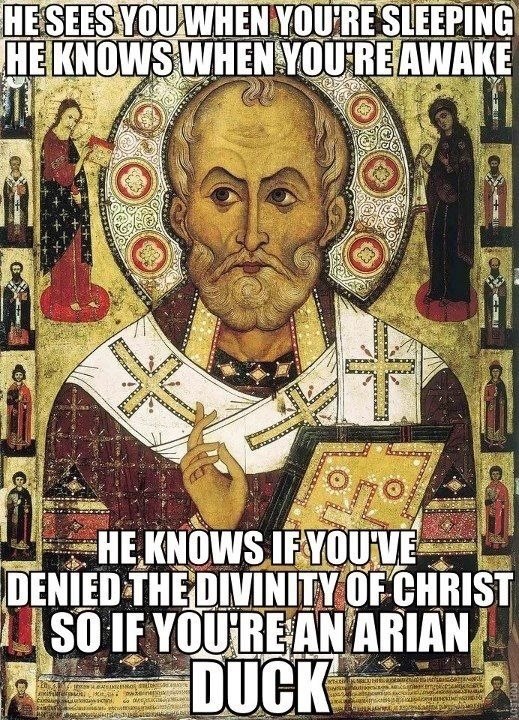
Santa, however, is making a list of all those who are naughty and nice, although these days he may be in contravention of GDPR by doing so. The tradition of a figure that rewards good behaviour and punishes bad behaviour is an old one, and is very useful for parents and other adults who want a way to control children. The real St Nicholas, a fourth century bishop from Greece, though, gave gifts not on the basis of behaviour but need. The most well-known of his acts of kindness is when he gave money to a penniless family so that the daughters could pay the dowries necessary to marry, thus rescuing them from being forced into prostitution. However, Nicholas is also alleged to have slapped someone at the First Council of Nicaea in 325AD. This Council was a gathering of bishops who discussed amongst other things the divinity of Jesus; according to a later legend Nicholas slapped someone who held the Arian belief that Jesus wasn't divine. So perhaps Santa should be giving to alleviate suffering and punishing heresy!


Categorizing people as good or bad is a very human trait, we love to put people into boxes or label them, although we very rarely put ourselves into the 'bad' category unless it's to say that we're a loveable rogue or too cool to be good. And this also colours a lot of people's idea of what happens when you die. After death, so this thinking goes, our life will be judged. Our good deeds put on one side of some scales and our bad deeds on the other. If our good deeds outweigh our bad deeds we get the reward of heaven, but if our bad deeds outweigh our good deeds we will be punished. This line of thinking usually also believes that most people will get rewarded and only a few really bad people (Hitler, Stalin etc.) will get punished.

I can't see why anyone would want to be judged on this criteria. Jesus tells us that no-one is good except God, and that being angry with someone is the same as murder, and James writes “For whoever keeps the whole law and yet stumbles at just one point is guilty of breaking all of it” (James 2:10). The pass mark for being 'good enough' for heaven is 100% and none of us can get anywhere near that. So is there any hope? Yes, because Christmas is about the coming of someone more exciting than Santa and who has a more important list.

In the book of Revelation, John has visions of the spiritual realm and he sees “Another book was opened, which is the book of life. The dead were judged according to what they had done as recorded in the books” (Revelation 20:12) and only those whose names are written in the book of life will enter into God's presence for eternity (Revelation 21:27). What are the deeds that have been done by those whose names are written in the book of life? They have had their sins forgiven through repentance and faith in Jesus (Revelation 3:5, 7:14 and 1:5). This Christmas, make sure your name is written on the only list that matters: Jesus' book of life.


Tuesday, 4 December 2018

Christmas Songs: 'I believe in Father Christmas'

A couple of years ago during Advent we had a series on the four songs of the first Christmas.  This year we're going to look at four popular Christmas songs.  This week it's “I believe in Father Christmas” by Greg Lake.


This is an odd song to be a Christmas favourite because is really an anti-Christmas song.  The singer recalls he was told the dream of Christmas and then remembers his disappointment and disillusionment when he finds that Christmas is not what he was promised.  And perhaps this is why this song is so popular, because it mirrors our own experiences of Christmas.  Everywhere we look we seem images of the perfect Christmas: perfectly white snow, perfectly cooked food, perfectly behaved family, perfectly chosen presents, but the reality is usually not quite so perfect!  The post-Christmas blues are not just caused by exhaustion and over-indulgence, but also by a sense of sadness that yet again Christmas didn't live up to the dream we'd been sold.

The song ends on a very chilling note: “the Christmas we get we deserve”.  In some ways this is obvious; if we want the world to be a better place we have to try our hardest to make it better.  But it also taps into a modern idea of 'karma', i.e. that if you do something bad then something bad will happen to you.  We sometimes see on social media a sort of glee as people look forward to karma getting revenge on someone who's harmed them.  But we know this isn't the way the world works.  We know that bad things happen to 'good' people and that good things happen to 'bad' people.  One biblical writer puts it this way: “it made me jealous to see proud and evil people and to watch them prosper...all goes well for them, and they live in peace. What good did it do me to keep my thoughts pure and refuse to do wrong? I am sick all day, and I am punished each morning” (Psalm 73:3,12-14 CEV).

Ironically, the modern concept of karma neither reflects reality nor does it correspond to the traditional understanding of karma.  In Hindu philosophy all karma is bad, it is like a debt that we all have.  Life is about doing good things to work off that debt and if we have worked off more karma than we accrue, when we die we are reincarnated as a better form of life. (Conversely if we increase our karma by doing bad we are reincarnated as a lower form of life).  The aim is to work off all our karma until we reach a state of nirvana, or non-existence.

It is the 'Israelite' of Lake's song that instead of being a fairy story is actually the answer to this problem, but first we need to recognise that actually all of us are 'bad' people.  Jesus said “No-one is good, except God alone” (Mark 10:18).  The Bible agrees that our badness or sin is like a debt, but it acknowledges that we cannot pay this debt off ourselves because we will always sin.  It also tells us that “We die only once, and then we are judged.  So Christ died only once to take away the sins of many people. But when he comes again, it will not be to take away sin. He will come to save everyone who is waiting for him” (Hebrews 9:27-28 CEV).  Sin and evil will be judged and punished when Jesus comes again, but those who ask God to forgive their sins and then seek to live his way will be saved.

And what is the biblical picture of salvation? “On this mountain the Lord All-Powerful will prepare for all nations a feast of the finest foods. Choice wines and the best meats will be served” (Isaiah 25:6 CEV).  “God’s home is now with his people. He will live with them, and they will be his own. Yes, God will make his home among his people. He will wipe all tears from their eyes, and there will be no more death, suffering, crying, or pain. These things of the past are gone forever” (Revelation 21:3-4 CEV).  Sounds like the perfect Christmas to me!

Saturday, 1 December 2018

An Alternative Nativity story

Here's my article for December:


Christmas is coming and for many of us we'll be hearing again the story of Jesus' birth at the first Christmas, or watching children act it out. Some of us may even go back to the source of the story, the Bible. Of the 66 books in the Bible, the four Gospels (Matthew, Mark, Luke and John) tell us about Jesus' life, death and resurrection. But only two of them tell us about Jesus' birth. John simply tells us of the eternal Word becoming flesh and living among us, and Mark says nothing about Jesus' birth at all. But of the other two only Matthew tells us about the visit of the wise men, and only Luke tells us about the shepherds in the fields. The Christmas story we retell is a composite story bringing in elements from Matthew's and Luke's accounts.

However, the birth of Jesus is also described in the book of Revelation but this account is radically different from the Gospels. In Revelation 12:1-6 John tells us of a vision he had of a woman giving birth to a son who “will rule all the nations with an iron sceptre” - a quote from Psalm 2 which the Early Church saw as referring to Jesus. So far, so normal. But the woman is described as being “clothed with the sun, with the moon under her feet and a crown of twelve stars on her head.” Stranger still, instead of being surrounded by angels, shepherds and adoring magi, next to the woman stood “an enormous red dragon with seven heads and ten horns and seven crowns on its heads...so that it might devour her child the moment he was born.” I'm yet to see a nativity play with this in!!

William Blake, The Great Red Dragon and the Woman Clothed with the Sun, c. 1805, National Gallery of Art, Washington DC 

The book of Revelation is packed full of strange images and complex symbolism which can make it tough reading It also makes it fertile ground for lots of different groups to claim they know exactly how to interpret each and every detail. Always be wary of anyone who is certain they know what it all means!! For example, the woman obviously represents Mary, who gave birth to Jesus, but she also represents Israel (the twelve stars remind us of the twelve tribes of Israel); and Creation (sun and moon); and Eve whose 'seed' will crush the serpent's head (Genesis 3:15); and from verse 6 onwards, the Church. The dragon is a major character in Revelation and the symbolism of his appearance is explored in more detail as the book goes on, but there is a parallel here with King Herod who wanted to kill the infant Jesus but, like the dragon, fails (Matthew 2).

So what are we to make of this third 'nativity'? It reminds us that the birth of Jesus has a cosmic and eternal significance. It's easy to hear the Christmas story as being like a fairy tale, but the reality is that it is the pivotal event in the battle between good and evil (the overall theme of Revelation). The dragon wants to devour the child at his most vulnerable because it knows that the child would ultimately defeat it. Throughout Revelation and the rest of the New Testament we discover that this defeat happens through the death and resurrection of Jesus (Colossians 2:15).

This is why the shepherds, angels and wise men come to worship the child; they recognised the universe-changing event that had taken place. As you hear again the Christmas story what will you hear: a fairy tale or the good news that the defeat of evil is now certain?

Friday, 8 December 2017

O tidings of comfort and joy!

Here is my December article:

The carol “God rest ye merry, gentlemen” is one my favourite carols, and it is for a lot of others too. Partly it's to do with the traditional sounding tune and partly it's because it expresses the emotions of Christmas- “O tidings of comfort and joy!”

Christmas for a lot of people is a time for joy: when you get together with loved ones for feasts and celebrations. Christmas is also a time that is often characterised by images of comfort: the sense of 'hygge' associated with candles, fires and lights shining in the darkness. These are of course all part of Christmas, but the 'tidings of comfort and joy' that Christmas brings go much deeper and are for everyone, including (and perhaps especially for) those who will be lonely, or in pain, or sorrowful this Christmas.

The carol is very clear about why the message of Christmas is one of comfort and joy: “for Jesus Christ our Saviour was born on Christmas Day.” Well, that sounds a very obvious thing to say about Christmas, (although you might struggle to find references to Jesus sometimes!) but it then goes on to remind us why this is good news. He came “to save us all from Satan's power when we had gone astray” and “to free all those who trust in him from Satan's power and might.” The reason Jesus' birth is special is because of his death. Christmas is only worth celebrating because of Easter.

This is truly joyful tidings! Sin is rebellion against God's authority; when we sin we ally ourselves with his arch-rebel, Satan, so we are under Satan's power. Once there, we can do nothing to free ourselves. However although we have rejected God, he never rejects us. So he showed his love to the world by sending his Son, Jesus, so that through his death our sins could be forgiven and we could be freed from Satan's power. For all those who keep trying to be good and failing, Jesus' birth is a reason to be joyful.

These are also comforting tidings, especially for those who feel burdened by guilt. Jesus' death comforts those who mourn as it assures us that God understands what grief is like, but more than that, Jesus' resurrection reminds us that eternal life is offered to the world. However, the comfort that Christmas brings is not just a consoling feeling, as 'comfort' is used in it's original meaning of 'strengthening'. By freeing us from Satan's power, Jesus strengthens us with the knowledge that God thinks we're worth dying for. As we've been freed from Satan's power and influence, with the knowledge of God's opinion of us and the promise of his Holy Spirit to help us, we are strengthened to live as children of God.


It is with these tidings that God will 'rest' (in the original sense of 'keep, or cause to remain') all of us, whether we're gentlemen or not, merry both at Christmas time and throughout the year. So in the name of Jesus, whose birth the angels announced and made shepherds rejoice, I bless you and your loved ones with knowing the true comfort and joy of Christmas.


Sunday, 4 December 2016

I'm dreaming of a hygge Christmas

Here's my article for the December magazine:

Each year the Collins dictionary announces its top ten 'words of the year'. Unsurprisingly this year's Word of the Year is 'Brexit' but also in the top ten was the Scandinavian word 'hygge' (pronounced hue-gah), which they define as “a concept, originating in Denmark, of creating cosy and convivial atmospheres that promote well-being.” Hygge is particularly felt around Christmas when we have images of candles, roaring fires, meals shared with loved ones. Christmas music also, perhaps unconsciously, taps into this concept of hygge: think about chestnuts roasting on an open fire; corn for popping and lights turned way down low; faithful friends who are dear to us gathering near to us once more.

Other cultures have similar concepts to hygge and in Hebrew the word 'shalom' captures some of the essence of hygge. Shalom is usually translated as 'peace' and is commonly used when greeting or saying goodbye to someone, however it also describes a feeling of contentment, completeness, wholeness, well being and harmony. It is this word, shalom, that is meant when Jesus is described as the Prince of Peace and when the angels sang ‘Glory to God in the highest heaven, and on earth peace to those on whom his favour rests’ (Luke 2:14).

To say that Jesus is the Prince of Peace is to say that Jesus is the ultimate, and ultimately the only source of contentment and wholeness. We get a glimpse of this through a concept like hygge – well-being is found not through power, status, money, beauty, productivity or other things we often spend our life trying to achieve, but through relationship. Ultimate well-being is found in a relationship with the Ultimate Being, God himself. As St Augustine famously said, our hearts are restless until the find their rest in God.

However, this relationship with God has been broken by our sin, by our turning away from God to follow our own desires. That's why the birth of Jesus is truly worth celebrating because he came to die to take the punishment for our sins, so now we can repent and turn away from our sins and have peace with God. We can be reconciled to him and our relationship with him is restored. To be reconciled with God is to know deep in our hearts his boundless love for us, to feel his favour resting on us, so we don't need to strive for acceptance through material possessions and status, in short we are content and made whole.

“Love and laughter and joy ever after, ours for the taking, just follow the master”


So this Christmas whether you're having a hygge Christmas or not, in the name of Jesus the Prince of Peace, “The Lord bless you and keep you; the Lord make his face shine on you and be gracious to you; the Lord turn his face towards you and give you peace.”

Monday, 28 November 2016

Christmas Playlist. 1: Mary's Song – What is God like?

Four songs that bring you to the heart of Christmas
1: Mary's Song – What is God like?

This Advent in our weekly sheets we're going to be looking at the four songs of the first Christmas, which were heard before, during and after the birth of the baby who lies at the heart of the real Christmas. The reflection will be adapted from Alistair Begg's book, 'Christmas Playlist' (buy it here. This week we're looking at Mary's Song – What is God like?

After discovering she is pregnant, Mary goes to the home of Zechariah and her relative, Elizabeth. While she is there, Mary breaks out into song, the first Christmas song in history (Luke 1:46-55), also known as the Magnificat. This is a song not about herself but about God and she describes God using two words: mindful (nothing to do with the Buddhist-based practice of mindfulness) and mighty.

Mary sings that God has been mindful of her even though she seems to be insignificant (v48). She glorifies – focuses on the greatness of – the Lord because although she may be very little in the eyes of the world, she is valuable in the eyes of the One who made the world. Mary also rejoices that God has been mindful of his people, Israel. Around 2,000 years before Mary sang, the God about whom she sang had made great promises to Abraham saying that his descendants would become a great nation who would be a blessing to all nations. Throughout the Old Testament, God reminded Abraham's descendants again and again that he remembered them and would keep his promises. He said he would do this through a son and Mary recognised that it was her son that was the sign that God had remembered his people and would fulfil his promises to them. Here is the God of Christmas, of history. He is a God who knows you, and he cares about you, and he makes promises to you, and he acts to help you.

Secondly, Mary sings that God is mighty, mightier than all the rulers of the earth. But he sometimes also uses his power to take away from us the things that make us think that we are mightier than we truly are, and that make us forget the God who is mightier than we are. He scatters the proud so that they can become humble. And then he lifts them up. He helps those who are humble enough to say I don't actually have it all together. I don't have all my questions answered. I have struggles that I need help with.


So what do you think about when you think about God? Mary might well have answered that question God is mindful of us and more mighty than us. And the truth that God is both all-caring and all-powerful made her heart “rejoice” - and it's a truth that causes hearts to rejoice still today.

Wednesday, 23 December 2015

Christmas traditions and Christmas truths

Last year's December magazine article:

Lying next to me on my desk, waiting to be opened is my pre-Christmas reading for this year – Pope Benedict XVI's book on the Infancy Narratives of Jesus of Nazareth. In this book Pope Benedict goes back to the stories of Jesus' infancy in Matthew and Luke's gospels to re-examine what they say and what they mean for us today. So far, so uncontroversial. Or so you'd think. Some in the media took a different view. A Reuters report pointed out that several attention-grabbing media headlines tried to make it seem as if Pope Benedict was attacking Christmas; headlines such as"Killjoy pope crushes Christmas nativity traditions," "Pope sets out to debunk Christmas myths," "The pope's war on Christmas," and even "Pope bans Christmas."

All of these headlines owe more to journalistic sensationalism than anything that was actually in the book. Pope Benedict, in returning to the gospel accounts themselves, pointed out how some of our ideas about the Christmas story are not supported by the gospels. For example, he says that the gospels do not say that there were any animals present when Jesus was born, and that the angels said “Glory to God in the highest” rather than sang it. Filtered through hyperbole these became the Pope banning nativity cribs and carols, even though in the book Pope Benedict states "No representation of the crib is complete without the ox and the ass" and "Christianity has always understood that the speech of angels is actually song" so it is only natural that we “join in their carolling on the Holy Night".

But something else, apart from journalists getting carried away, lies behind these headlines, and that is the challenging of traditions. Christmas is a time full of traditions both old and new, most of which are dearly held, and sometimes these traditions compete. Arguments over whether your have Christmas pudding before or after the Queen's speech, or whether you see all of the family on Christmas Day or none of them, although trivial can take on epic proportions precisely because they are to do with some of our most cherished habits.


In his book Pope Benedict seeks to look beyond the various Christian traditions to the 'gospel truth' of the Christmas story, not to get rid of them but to enhance them by reminding us of the greater truth that lies at the heart of the story. This Christmas, why not pick up a Bible and read the first part of Matthew and Luke's gospels and hear the original story again (or come along to church to hear it!). To use Pope Benedict's words, I pray that the many Christmas traditions, but especially the gospel accounts themselves, will “help you on your path toward and alongside Jesus”. God bless you this Christmas.

Thursday, 3 December 2015

Penguins, Pagans and Real Love

 For me, one of the memorable parts of last year's Christmas was the John Lewis advert; the story of friendship and love with a boy, Sam and his best friend, Monty the penguin. As well as a great story, what made the advert so memorable was the soundtrack, 'Real Love' sung by Tom Odell.

'Real Love' was originally written by John Lennon around 1977 and recorded with overdubs by the three surviving Beatles in 1995. The song is a celebration of true and real love and also a reflection on how life can sometimes be a preparation or almost a kind of dress rehearsal for true love. The lyrics say “Just like little girls and boys, playing with their little toys. Seems like all they really were doing, was waiting for love.”

Advent is the season of preparation for Christmas in terms of getting decorations, food and plans ready but also in the deeper sense of preparing ourselves to celebrate again the great moment when God came to earth to be born as a human, Jesus Christ. One of the ways we do this is to look back at how God prepared his people, the Israelites, for it so we look into the Old Testament for the prophesies about Jesus and also at the people and events that foreshadowed what Jesus would do. For example we look Isaiah's foretelling of a virgin giving birth to a son (Isaiah 7:4), and we also think about the lamb whose blood saved the Israelites from the tenth plague God sent to Egypt at the Passover and how that prefigures Jesus' death which saves us from God's judgement. In our Advent Bible studies this year, we're looking at the Letter to the Hebrews and what it tells us about how the Old Testament prepares us for Jesus.

But God's preparation for the coming of Jesus wasn't limited to the Israelites. It is often said that Christmas and Easter have more to do with Roman or pagan festivals than they do to the story of Jesus, and it is true that the celebration of Christmas and Easter were linked with pre-existing festivals. But far from devaluing the Christian festivals this knowledge enhances them because it shows how God reveals himself through all people's attempts to understand ourselves and the world. Acts 17 recounts how St Paul in Athens used the kernel of truth in the Greek religious practices and thinking to explain the full truth revealed in Jesus.


God uses the world around us, our lives and our thinking to prepare us for understanding Jesus. The kernels of truth found in all religions and philosophies are like playing with toys while waiting for the full and real truth which is found in Jesus. And all our attempts to love other people are pale reflections of the real love that we see when God comes to earth in Jesus. So this Christmas I invite you to discover the greatest gift of all: God's love for you. “Don't need to be alone...don't need to be afraid. It's real love.”