I am the Rector of two of the three churches in the world dedicated to St Hybald, one of which (Hibaldstow) contains his remains. This blog is mainly for my monthly parish magazine articles.

Disclaimer: Calling myself "Hybald's Rector" does not imply that St Hybald would agree with everything I say!!

Showing posts with label Judgement. Show all posts

Tuesday, 10 September 2024

The Opening of the Sixth Seal (Revelation 6:12-17)

Sermon on the Opening of the Sixth Seal
Preached at St Andrew's, Redbourne
31st July 2022

Photo by J.Guffogg & J.Hannan (flickr.com)


[Jesus said]
29 “Immediately after the distress of those days
“‘the sun will be darkened,
    and the moon will not give its light;
the stars will fall from the sky,
    and the heavenly bodies will be shaken.’ [Isaiah 13:10; 34:4]

30 “Then will appear the sign of the Son of Man in heaven. And then all the peoples of the earth will mourn when they see the Son of Man coming on the clouds of heaven, with power and great glory. 31 And he will send his angels with a loud trumpet call, and they will gather his elect from the four winds, from one end of the heavens to the other.

32 “Now learn this lesson from the fig tree: As soon as its twigs get tender and its leaves come out, you know that summer is near. 33 Even so, when you see all these things, you know that it is near, right at the door. 34 Truly I tell you, this generation will certainly not pass away until all these things have happened. 35 Heaven and earth will pass away, but my words will never pass away.

36 “But about that day or hour no one knows, not even the angels in heaven, nor the Son, but only the Father. 37 As it was in the days of Noah, so it will be at the coming of the Son of Man. 38 For in the days before the flood, people were eating and drinking, marrying and giving in marriage, up to the day Noah entered the ark; 39 and they knew nothing about what would happen until the flood came and took them all away. That is how it will be at the coming of the Son of Man.”
12 I watched as he opened the sixth seal. There was a great earthquake. The sun turned black like sackcloth made of goat hair, the whole moon turned blood red, 13 and the stars in the sky fell to earth, as figs drop from a fig tree when shaken by a strong wind. 14 The heavens receded like a scroll being rolled up, and every mountain and island was removed from its place.

15 Then the kings of the earth, the princes, the generals, the rich, the mighty, and everyone else, both slave and free, hid in caves and among the rocks of the mountains. 16 They called to the mountains and the rocks, “Fall on us and hide us from the face of him who sits on the throne and from the wrath of the Lamb!17 For the great day of their wrath has come, and who can withstand it?”


Sermon

Are you sitting comfortably? Well you might not be at the end of this sermon!  But before we get into the subjects of hell-fire and damnation depicted in our window and the passage it's based, I want to highlight the Gospel reading we had from Matthew 24.  This is Jesus teaching about his second coming.  And the reason I wanted to have this as our first reading is because when the subjects of judgement and hell come up, an objection is often raised that these subjects aren't very Jesus-like: the argument goes that Jesus' major teaching is about love and that a God of love cannot be a God of judgement.

Our passage from Matthew 24 reminds us that Jesus was just as happy teaching about judgement as he was about love, and reading through the rest of the gospels it is arguable that he taught more often about judgement than he did about love.  And it is precisely because he is a God of love that he is also a God of judgement: it is because he loves his creation so much that he cannot bear anything that mars and disfigures it, and that he must punish whatever does.  And top of that list for judgement is humanity, through whom sin has come into the world and spoiled God's perfect creation.  But I'm getting ahead of myself; the important thing to remember for now is that the teaching in Revelation 6 is perfectly consistent with Jesus' own teaching, which in turn is consistent with the teaching in the Old Testament.

So let's now turn to think about our window.

The title is “The Opening of the Sixth Seal” which we can also deduce from the image at the bottom of the window of a lamb with a flag [Fig. 1].  There are seven ribbons hanging down beneath the lamb, the first five have nothing at the end, the seventh has a seal with a cross on it, and the sixth has a broken seal.  But before we can understand what's happening in the window, we need to think about what's happening in the book of Revelation up to this point.

 Figure 1: Photo by Steven Graham (www.in-glass.uk) from Facebook


John, the writer of the book, is having a vision from Jesus in which he is being shown “what is now and what will take place later” (Revelation 1:19).  As part of this he sees the throne room of heaven, which is recorded in Revelation 5.  On the throne he sees God who is holding a scroll with seven seals on it.  This scroll contains God's instructions and judgments and opening it would signal that these instructions are to be carried out.  The seven seals are for each of the seven instructions, with the number seven (like elsewhere in Revelation) symbolising perfection and completeness.  So we need to imagine a scroll with something like wax seals keeping it closed.

And here is where we need to be a bit careful about our language, because this reminds me of my favourite story of theological illiteracy.  You may remember the David Koresh cult in the early 1990s; one of my professors had an academic interest in end-of-the-world cults and spoke to former members for research.  He told the story that in 1993 the FBI laid siege to the Branch Davidians' headquarters at the Mount Carmel Centre in Waco, Texas.  As part of the negotiations during this siege, Koresh told the FBI that they had to stay there until the seven seals were opened, referring of course to Revelation.  However, on hearing this the FBI called in the American Society for the Prevention of Cruelty to Animals, because they thought that some seals were going to be slaughtered!

So just to be clear, today we are talking about wax seals not sea creatures!

But back to Revelation.  God is holding out the scroll with seven wax seals on it and John weeps because there is no-one worthy to open the seals, meaning there is no-one worthy to pass judgment.  Then one of the elders says “Do not weep! See, the Lion of the tribe of Judah, the Root of David, has triumphed. He is able to open the scroll and its seven seals” (Revelation 5:5).  So John looks up and sees a Lamb, who had been slain and he takes the scroll, resulting in the song of praise which we said in our opening canticle.

Revelation 6 describes the opening of each of the seals, ending the chapter with our second reading, and our theme: the opening of the sixth seal.  It starts with a dramatic description of the literally earth-shattering events so vividly depicted in the window: the blood-red moon and shattered rocks [Fig. 2];

Figure 2: Photo by Steven Graham (www.in-glass.uk) from Facebook


the darkness with the skies receding, revealing the light of God's presence [Fig. 3]. 

Figure 3: Photo by Steven Graham (www.in-glass.uk) from Facebook


And most dramatically, the reactions of the people, mostly knocked down or cowering. We see a king fallen, with his crown and sceptre rolling away, and a general, upside down with his sword out of reach, and treasures spilled on the floor [Fig. 4].

Figure 4: Photo by J.Guffogg & J.Hannan (flickr.com)


So what's going on?  We know from Jesus' words, from the Old Testament passages he's alluding to and from what's happening in the vision that this is a description of judgment, and that the day of judgment will be a day of mourning.  This is because on the Day of Judgement, as God says in Ezekiel “I will judge you according to your conduct and repay you for all your detestable practices” (Ezekiel 7:3).  That is why the people in Revelation 6 cry out for the rocks and mountains to fall on them and hide them from God and his judgment, because as it says in Psalm 130:3 “If you, Lord, kept a record of sins, Lord, who could stand?”  When we are faced with the holiness of God, we realise our own sinfulness and our inability to live a good life compared with God's standard of goodness.  We realise that “all have sinned and fall short of the glory of God” (Romans 3:23) and that it doesn't matter if we're rich or poor, powerful or weak, kings or generals, none of our talents or achievements can make up for our sins.

When we realise our sins we also realise the consequences of our sins.  As Jesus said in the parable of the net: “Once again, the kingdom of heaven is like a net that was let down into the lake and caught all kinds of fish. When it was full, the fishermen pulled it up on the shore. Then they sat down and collected the good fish in baskets, but threw the bad away. This is how it will be at the end of the age. The angels will come and separate the wicked from the righteous and throw them into the blazing furnace, where there will be weeping and gnashing of teeth." (Matthew 13:47-50).  And we see this at the bottom right of the window, [Fig. 5] where those who have been judged are falling into the blazing furnace and barely recognisable as human.

 Figure 5: Photo by Steven Graham (www.in-glass.uk) from Facebook


So the question that faces us as we look upon this graphic description and portrayal of the Day of Judgement is the one the people in Revelation 6 and the Psalmist ask: in the face of God's all-knowing judgement, who can stand?

If we turn back to the window there is one figure standing [Fig. 6] almost in the centre of the picture: and he has broken chains hanging from his wrists.

 Figure 6: Photo by Steven Graham (www.in-glass.uk) from Facebook


He probably represents those whose chains of judgment have been broken, i.e. those who have been judged and have been forgiven.  This possibility of redemption could also be suggested by the zig-zag of light in the top right [Fig. 7] which might be lightning splitting the rocks or it could be a path back to the light of the presence of God.

 Figure 7: Photo by Steven Graham (www.in-glass.uk) from Facebook


So how can the chains of judgement be broken; how can we be forgiven; how can we stand in the face of God's judgment?

For the answer to that question we need to turn to Revelation 7, which is still part of the opening of the sixth seal.  In this chapter we hear about more seals (and again not of the sea variety!), and this time they are not sealing up scrolls, but are more like a stamp of ownership and they are on the heads of the servants of God (Revelation 7:3).  John is told that there are 144,000 of them which is symbolic of 12 times 12,000 representing the combining of the Old Covenant (the twelve tribes of Israel) and New Covenant (the Church represented by the twelve apostles).  The whole people of God.  But just as John was told about the Lion of Judah being able to open the scroll and when he looked he saw a Lamb, so he is told about 144,000 people and when he looks he sees “a great multitude that no one could count, from every nation, tribe, people and language, standing before the throne and before the Lamb. They were wearing white robes and were holding palm branches in their hands” (Revelation 7:9).  We are told that “they have washed their robes and made them white in the blood of the Lamb” (Revelation 7:14).

So the whiteness of their robes is not because they lived lives of total holiness and purity, because as we've just heard, all have sinned and fall short of the glory of God.  But instead their robes have been washed in the blood of the Lamb.  What does this mean?  Well, the background is the story of the Passover in Exodus 12.  God warned that he was going to send a final plague on Egypt, the death of the first-born, but that if the Israelites put the blood of a spotless lamb on their door-posts, the angel of judgment would pass over those houses.  Fast-forward to the New Testament, where Jesus is called the Lamb of God, who takes away the sin of the world (John 1:29) and whose death is seen as the sacrifice necessary for the punishment of sin.  And in Revelation 1:5 Jesus is described as the one who “loves us and has freed us from our sins by his blood”  Therefore, those who connect themselves with Jesus' death are 'passed over' on the day of judgment.

How does this happen? On the day of Pentecost Peter quoted the prophet Joel talking about the day of judgement in language reflected in Revelation 6, and said that “everyone who calls on the name of the Lord shall be saved” (Acts 2:21; Joel 2:32).  And calling on the name of the Lord meant repenting of sins and asking him for the forgiveness that is possible because he has died in our place.

The people facing the opening of the scroll of judgement ask: who can stand?  The answer is those whose sins have been forgiven by their repentance and trust in Jesus' atoning death.

We don't often talk about judgement.  Partly for the correct reason that we should not be pointing out other people's sins.  Jesus tells us “Do not judge, or you too will be judged...Why do you look at the speck of sawdust in your brother’s eye and pay no attention to the plank in your own eye?” (Matthew 7:1,3).  But mainly because we don't like the idea that one day we will be judged, and we will be found guilty and deserving of eternal punishment.  We can and should warn people of the actions that God himself has told us are sinful, but we should do that in the knowledge that we too are sinful, and just as guilty as they are.

So what do we do when we look on an image such as this window, which depicts very clearly the consequences of the coming judgement?  Do we admire its artistry but dismiss its subject as being a relic of mediƦval theology, designed to scare people into submission to church authorities?  Do we celebrate our more enlightened thinking and carry on living for the present with no thought for the future?  Do we hide behind our wealth, our intelligence, our achievements, our popularity, our good works and hope that God won't notice our sins?

Or do we listen to Jesus, who when describing his coming to judge the living and the dead said “Heaven and earth will pass away, but my words will never pass away” (Matthew 24:35)?  He is the firm and steady Rock on whom we can build our lives; he is the Rock in which we can hide so that judgment will pass over us.

Jesus will come again and will judge the living and the dead, and as no-one knows the day or time it may even be today!  If the thought of facing the judgement throne of God today makes you uncomfortable in your seat, then good!  Come to Jesus, the Lamb who was slain, the Rock who was broken; repent and ask him to break the chains of judgment caused by your sin and wash you clean.

Sunday, 8 October 2023

Harvest: a created illustration

OIKOS is a fantastic ecumenical initiative in Brigg, that run a Christian shop, a Food Bank, a Community Pantry and more!  I was asked to write some short 'thoughts to start your week' for October 2023 for their Facebook page. This is an expanded version of the thought for 8th October.


As you read through the Gospels you may notice how many times Jesus uses images from the natural world or agriculture: parables set in fields and vineyards; lilies and sparrows to teach us about God's provision for us; trees to warn us of coming judgement; and famously he calls himself the Good Shepherd. In some ways this is no surprise; Jesus lived and taught in an agricultural society so like any good teacher he would have used illustrations that his audience were familiar with, and you can imagine him standing in the countryside pointing to what's around him as he talks.

But perhaps there's more to it than that. This possibility arises when we consider that the Jesus who tells these stories and uses theses illustrations is the same Jesus who made that creation in the first place! This then raises the possibility that he designed and created them in order that he could then use them to teach us something when he came to earth. Therefore creation itself becomes a way in which God communicates to us.

We see this in Psalm 19:1 when Psalmist exclaims “The heavens declare the glory of God; the skies proclaim the work of his hands.” And Paul also teaches us that “what may be known about God is plain to them, because God has made it plain to them. For since the creation of the world God’s invisible qualities—his eternal power and divine nature—have been clearly seen, being understood from what has been made, so that people are without excuse. (Romans 1:19-20). So the natural world isn't just a convenient illustration, but it is designed to be an illustration.

So what then might harvest teach us? We take for granted that harvest is part of the natural agricultural cycle of preparation, planting, tending and harvesting, but it is not a necessity that nature works in this way. God could have created a world where all foods were available all year round but instead he created one that involves this cycle. And perhaps he did that so that we have a part to play in the process - as the great harvest hymn reminds us: “We plough the fields and scatter the good seed on the land, but it is fed and watered by God’s almighty hand.” In co-operating with God in the tending and production of food we exercise the likeness of God in which we were made. We are co-creators with him – not, of course, in the original creation but in the ongoing creation.

Harvest itself, as Jesus highlighted, primarily teaches us about a time of judgment (for example Matthew 13). The crop is gathered in and the wheat is sorted from the chaff, the good and the bad are separated with the good going to the owner's barn and the bad being destroyed. Jesus says that on the Day of Judgement the 'good' will be the people of the kingdom who have heard his word and obey it, who repent and turn to him as their Saviour and Lord.

Wednesday, 27 November 2019

"I'm not as bad as Hitler"

Here's my article for the November magazine:


This year marks the 80th anniversary of the start of World War Two and also, perhaps, the start of a new way to personify pure evil. During WWII, the person of Adolf Hitler was unsurprisingly used by the Allied nations in their propaganda to illustrate the immorality of the Nazi regime. However, this association of Hilter with evil continues to the present day in a way that isn't true of Kaiser Wilhelm who was used in similar propaganda in WWI. Hitler continues to be used to personify evil; perhaps because in our secular world that cannot acknowledge a supernatural realm, there needs to be something to replace the devil.

Hitler has also indirectly contributed to the field of logic. A reductio ad Hitlerum is an attempt to invalidate someone else's position on the basis that the same view was held by Adolf Hitler, e.g. he was a vegetarian and against smoking. In the world of the Internet, Godwin's rule asserts that “As an online discussion grows longer, the probability of a comparison involving Nazis or Hitler approaches 1”. This has the unfortunate side-effect that making any reference to Hitler or the Nazis, however justified, is now seen as a reason not to listen to that argument. This is particularly dangerous when it comes to issues of censorship and restrictions on freedoms of speech and belief, which were used by the Nazis to quash any opposition or disagreement and are also increasingly used today to stop any questioning of the cultural zeitgeist.

There is another way that Hitler is used in arguments. Again he is used as the embodiment of evil, but this time people use him to compare themselves with: they say “I may not be perfect, but I'm not as bad as Hitler.” This has particularly dire consequences when it comes to the subject of sin and judgement. The Bible teaches us that one day Jesus will return to judge the living and the dead (1 Peter 4:5). It reminds us that we have all sinned and fallen short of God's standard (Romans3:23) and that we all therefore need to repent in order to be forgiven (Acts 3:19) and enjoy eternal life with God (Revelation 21:27).

Now I doubt whether anyone considers themselves to be perfect, but the problem is that when we compare our sins to other peoples' sins we will always be able to think of people who do worse or more sins than us, and if we can't, we can always rely on the argument that “I'm not as bad as Hitler”! When we do this we minimise and trivialise our sins to such an extent that we don't feel the need to repent. But if we look at this from God's point of view rather than our own we see that “the person who keeps every law of God but makes one little slip is just as guilty as the person who has broken every law there is” (James2:10 The Living Bible), because Jesus tells us that the standard is to be as perfect as God himself (Matthew 5:48).

To have a right view of ourselves is to say that we are just as bad a Hitler and that we don't deserve eternal life any more than he does, no matter how many good things we do in our lives. But the glorious good news is that even though we are that bad, Jesus died to take our punishment so that through belief in him we can enjoy eternal life with God and with no more pain, suffering or war.

Friday, 25 October 2019

Thank God for the 'little people'

Here's my sermon from Broughton Town Council's Civic Service earlier this month.  The readings were Galatians 6:7-10 and Matthew 25:31-40:


My wife and I share a common interest in History although we don't tend to like the same periods, nor do we agree on the type of history we're interested in.  For me the best history is about kings and battles – geopolitical history, but Mags is much more interested in people and the way they lived – social history.  So I was in my element last year when we stood on the fields of Waterloo, whereas Mags much preferred it in Beamish a few years earlier.

It's easy to think that the course of history is driven by those kings and battles, by the big people, but as Gavroche reminds us in Les Miserables “the world is big but little people turn it around”.  This song is about how children especially can make a big difference, and it's great to have representatives of the the Rainbows, Brownies and Guides here with us today, reminding us of the many great children and young people that we have in Broughton.  But the meaning of the song is also extended to the 'little people' in the world - those seemingly without power and influence, because 'little people' do turn this big world around.  Those battles wouldn't have happened without the 'little people' fighting in them, and we all know the history of revolutions where the 'little people' can overthrow even the most omnipotent ruler.  Of course the most influential 'little person' ever was Jesus himself: the son of a carpenter, who spent only three years travelling around an obscure outpost of the Roman Empire two thousand years ago.  Yet everything that we can see around us stems from him and the work of his followers – not just the church building but the technology we use, the clothes we wear, the medicines that have kept us alive, the music we sing, the society we live in, the art and literature and sport we enjoy.  Nobody, whether a 'big person' or a 'little person', has done more to shape and influence the world than the 'little person' Jesus Christ.

Of course, God Almighty could have made all those things happen merely by ordering it to be so.  We see in the book of Genesis that that whole universe only exists because God willed it into existence.  But instead he chose to come to earth, to become a 'little person' and change the world through his teaching, and through his life, death and resurrection.  And one of the reasons he did that was to show how important each one of us is. Whether we consider ourselves to be 'big' or 'little' each one of us has a dignity.  And contrary to the ruling of a British court this week that Genesis 1 is “incompatible with human dignity”, in fact Genesis 1 is the only firm foundation for human dignity.  Our human dignity cannot be based on our beauty, or our intelligence, or our skills, or our usefulness to others, or on the 4% of our genes that distinguish us from chimps.  Our human dignity can only be based on the belief that we are made in the image and likeness of God – that is the only thing we cannot lose, that is the only thing that gives us all equal worth, that is the only thing that means that 'little people' count as much as 'big people'.

And because we all have human dignity, the actions we do to and for each other matter enormously.  Our Civic Service gives us the opportunity to recognise the huge amount of work that is done by those who might think of themselves as 'little people' and to say 'thank you' to them.  They are the people who turn this world around and who do so much good for this community of Broughton.  St Paul reminds us in his letter to the Galatian church “Let us not become weary in doing good, for at the proper time we will reap a harvest if we do not give up”.  We are in the middle of Harvest season, when we think about the little seeds which were planted earlier in the year that we are now able to harvest and enjoy.  St Paul uses that to illustrate the benefits that result from the 'little' actions of 'little' people.  We have so many people who give their time and energy to help this community and the result is a community that we can be proud of.  The hard work and preparation that go into a lot of community events and projects, and community life itself, is often unseen, but the results, like the harvest, often can.   There are too many people to name individually and there are also many different areas and aspects of the life of this community in which they work.  It would be wrong to start giving examples because either I would miss people out, or because the tea will go cold in the Village Hall!

But there are are also thousands of tiny actions we can do each day that make the world a better place: a smile, a kind word, a prayer.  Most of these will go unnoticed and uncelebrated.  However, Jesus' parable in our reading from Matthew assures us that on Judgement Day, each and every good thing we have done will be noticed and celebrated, and we will see the full effect of them.  And that's an amazing thought!  The same is true of our bad deeds, and that is a more frightening prospect, but the promise of Jesus is that the slate will be wiped clean for those who repent of their sins.

So today we gather to celebrate all those people whose actions both small and large make this community a better place.  Thank you, but most of all thank God for you!

Tuesday, 11 December 2018

Christmas Songs: "Santa Claus is coming to town"

A couple of years ago during Advent we had a series on the four songs of the first Christmas.  This year we're going to look at four popular Christmas songs.  This week it's “Santa Claus is coming to town”.


This is one of those songs where the music and the lyrics are seemingly at odds with each other. The music is very jolly which makes it sound like it's a song of joy celebrating the imminent arrival of Santa with “little tin horns and little toy drums, Rooty toot toots and rummy tum tums...And curly head dolls...Elephants, boats, and kiddie cars too”. On the other hand the lyrics are a not-so-veiled threat aimed at children that if they don't behave (even when they're sleeping!) they won't get those goodies. A similar threat is heard daily from parents to their children: “if you don't behave you won't get any presents!” although it is rarely, if ever, carried out.

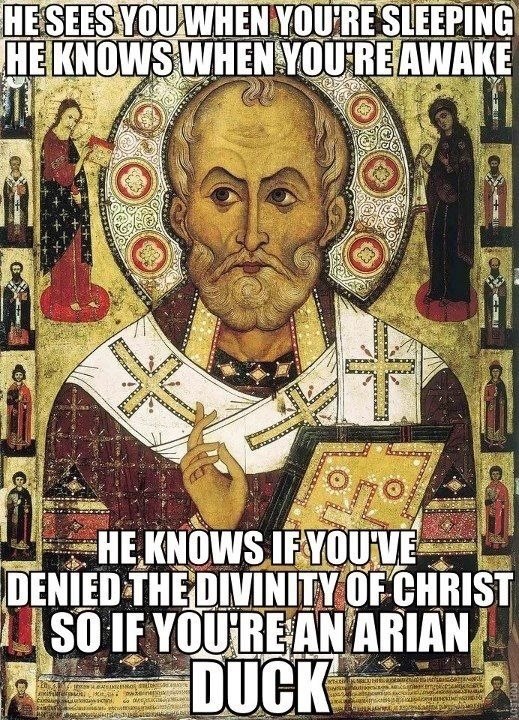
Santa, however, is making a list of all those who are naughty and nice, although these days he may be in contravention of GDPR by doing so. The tradition of a figure that rewards good behaviour and punishes bad behaviour is an old one, and is very useful for parents and other adults who want a way to control children. The real St Nicholas, a fourth century bishop from Greece, though, gave gifts not on the basis of behaviour but need. The most well-known of his acts of kindness is when he gave money to a penniless family so that the daughters could pay the dowries necessary to marry, thus rescuing them from being forced into prostitution. However, Nicholas is also alleged to have slapped someone at the First Council of Nicaea in 325AD. This Council was a gathering of bishops who discussed amongst other things the divinity of Jesus; according to a later legend Nicholas slapped someone who held the Arian belief that Jesus wasn't divine. So perhaps Santa should be giving to alleviate suffering and punishing heresy!


Categorizing people as good or bad is a very human trait, we love to put people into boxes or label them, although we very rarely put ourselves into the 'bad' category unless it's to say that we're a loveable rogue or too cool to be good. And this also colours a lot of people's idea of what happens when you die. After death, so this thinking goes, our life will be judged. Our good deeds put on one side of some scales and our bad deeds on the other. If our good deeds outweigh our bad deeds we get the reward of heaven, but if our bad deeds outweigh our good deeds we will be punished. This line of thinking usually also believes that most people will get rewarded and only a few really bad people (Hitler, Stalin etc.) will get punished.

I can't see why anyone would want to be judged on this criteria. Jesus tells us that no-one is good except God, and that being angry with someone is the same as murder, and James writes “For whoever keeps the whole law and yet stumbles at just one point is guilty of breaking all of it” (James 2:10). The pass mark for being 'good enough' for heaven is 100% and none of us can get anywhere near that. So is there any hope? Yes, because Christmas is about the coming of someone more exciting than Santa and who has a more important list.

In the book of Revelation, John has visions of the spiritual realm and he sees “Another book was opened, which is the book of life. The dead were judged according to what they had done as recorded in the books” (Revelation 20:12) and only those whose names are written in the book of life will enter into God's presence for eternity (Revelation 21:27). What are the deeds that have been done by those whose names are written in the book of life? They have had their sins forgiven through repentance and faith in Jesus (Revelation 3:5, 7:14 and 1:5). This Christmas, make sure your name is written on the only list that matters: Jesus' book of life.


Monday, 9 July 2018

The hills are alive with the sound of praising

Here's my article for Broughton's July magazine:


It's one of the greatest cinematic opening sequences. The camera swoops down over the mountains and zooms in on a woman running across a meadow; the orchestra swells and as we focus in on her she begins to sing “The hills are alive with the sound of music”. I don't know if the beginning of Broughton Primary School's production of the Sound of Music will be quite as dramatic but I'm sure that the whole of the show will be brilliant as usual.

That uplifting opening song uses the image of the natural world being alive with the sound of music and of humanity joining in with that music. But this isn't just a poetic image of how the noises in the world could be heard as musical, rather it is actually a description, perhaps unknowingly, of a deep biblical truth. Isaiah 49:13 says “Shout for joy, you heavens; rejoice, you earth; burst into song, you mountains!”, and 1 Chronicles 16:32-33 says “Let the sea resound, and all that is in it; let the fields be jubilant, and everything in them! Let the trees of the forest sing, let them sing for joy before the Lord”. Many other places in the Bible talk of creation singing and making music and the book of Psalms, Israel's hymn book, ends with this verse “Let everything that has breath praise the Lord.” (Psalm 150:6).

The Bible affirms that all creation has this musical quality, but unlike the song in the musical, this is not just a way of describing a joyous 'life force' that connects every part of the natural world. The musicality of creation, including humanity, has a purpose, and that purpose is to praise God. Revelation 4, echoing Isaiah 6, describes some of what goes on in heaven speaking about the angels constantly saying “Holy, holy, holy is the Lord God Almighty.” (Traditionally the speech of angels is said to be the same as human song). So the constant music of creation joins in with the constant song of heaven to praise God.

We praise God for who he is, but we also praise him for what he does. 1 Chronicles 16 gives two of God's wonderful acts that particularly deserve praise. Verse 23 says “Sing to the Lord, all the earth; proclaim his salvation day after day” and in verse 33 creation sings because he comes to judge the earth. So creation praises God because of his judgement and his salvation.

It may seem odd to praise God for his judgement, but deep down it's what we all crave. We see a world where to much is wrong and we long for it to be put right; we see evil seemingly unpunished in this word and long for there to be justice. However, the problem is that justice demands that all wrongdoing is punished. Jesus commands us to “Be perfect, therefore, as your heavenly Father is perfect” (Matthew 5:48) but Romans 3:23 reminds us that “all have sinned and fall short of the glory of God” and Psalm 130:3 asks “If you, Lord, kept a record of sins, Lord, who could stand?” Only what is holy can enter the presence of the Holy God and we are all far from holy.

Therefore, we also rejoice in God's salvation. Romans 3 goes on to say “all are justified freely by his grace through the redemption that came by Christ Jesus. God presented Christ as a sacrifice of atonement, through the shedding of his blood – to be received by faith.” Jesus died to take the punishment we deserve so that through repentance and faith in him we can be forgiven. And as we turn to the Lord “the mountains and hills will burst into song before you, and all the trees of the field will clap their hands” (Isaiah 55:12).

Tuesday, 22 December 2015

Advent Reflections - The Four Last Things: 4. Hell

Easrt window of St Andrew's, Redbourne - "The Opening of the Sixth Seal" (Revelation 6:12-17)
 Finishing our meditations on the four traditional themes of Advent
Death, Judgement, Heaven and Hell; this week we're thinking about Hell

Just as we need to rid ourselves of the mental image of heaven being fluffy white clouds and harps, so we need to rid ourselves of the image of hell as sulphurous fires and devils with toasting-forks doing unspeakable things to people forever. However, these images owe more to mediƦval imagination than the biblical record. So what does the bible say about hell?

In the bible there are three words that are usually translated 'hell': sheol, Hades and gehenna. Sheol is a Hebrew word that can mean 'grave', 'pit' or the 'realm of the dead' and is quite neutral, but it is also used in a sense more like what we would think of as hell – a place of punishment. Hades likewise can simply mean the underworld or realm of the dead, but is occasionally used in a context that speaks of punishment. Gehenna is the name of a rubbish dump south of Jerusalem where the filth and dead animals from the city were thrown into in a fire that burned constantly. This is used by Jesus as an illustration of what Jerusalem will become like if it doesn't follow him and by extension an illustration of the outcome for everyone who rejects him.

In order to think about hell we need to remind ourselves of what was said previously about judgement. God is perfectly holy and only perfectly holy beings can be in his kingdom, and on this criteria we all fail and no-one deserves to enter his kingdom. However, because Jesus died to take the punishment we deserve, we can be forgiven and we can enter God's kingdom. But we can only be forgiven if we ask for it. God gives us the free will to be able to choose him or reject him and he honours our decision, but if we reject Jesus we also reject the way to salvation. God “wants all people to be saved and to come to a knowledge of the truth” (1 Timothy 2:4) and he “so loved the world that he gave his one and only Son, that whoever believes in him shall not perish but have eternal life. For God did not send his Son into the world to condemn the world, but to save the world through him. Whoever believes in him is not condemned, but whoever does not believe stands condemned already because they have not believed in the name of God’s one and only Son” (John 3:16-18).

On Judgement Day we will see God face-to-face and we will know his verdict on us, and we will know it to be absolutely just and fair. Those who choose to reject Jesus in this life will have that decision honoured in the next; those who choose to be judged on the basis of how good they are will be judged on that basis and be found wanting; those who choose to accept the forgiveness offered by Jesus and unite themselves with him will be judged as he is and be found acceptable to God.

So what happens to those who reject Jesus? In rejecting Jesus they reject his offer of taking the punishment for their sins, therefore in order that justice may be done, punishment is still required. We know that this justice does not come before death so it must come after death. So the question is, what form will this punishment take? The simple answer is that we don't know for sure. Jesus and other parts of the bible use language to describe it, with fire and torment being common images, but it is not clear whether this language is meant to be literal or symbolic. The 'torment' may not mean physical pain but mental anguish at the realisation of the consequence of rejecting Jesus, as Charles Wesley graphically describes it: “deeply wailing shall the true Messiah see.”

The good news of Christianity about hell is that whatever it is, it is not where we're meant to be. God created us to be with him forever and although because of our sins we spoilt that plan, because of Jesus' death that relationship with God for eternity is possible again. Thinking about the 'Four Last Things' reminds us that our future lies in our hands, Jesus invites us to repent and believe in him. What is your response?


Tuesday, 8 December 2015

Advent Reflections - The Four Last Things: 2. Judgement

 Continuing our meditations on the four traditional themes of Advent
- Death, Judgement, Heaven and Hell; this week it's Judgement.

Divine judgement often makes us feel very defensive if not angry - “who are you to judge me?” is an unspoken question in our minds. And this is particularly so in a society where any notion of an absolute moral standard is dismissed. Society believes that the morality of an action depends on the situation rather than any concept of rightness or wrongness. Added to which is the relativist idea of something being “right for me” so that what is right for you is not necessarily right for me and you shouldn't impose your 'rightness' on me.

Yet at the same time we cry out for justice. Our world is seemingly full of people who do bad things and get away with them, things like murder, fraud, dishonesty or hurting us in a more personal way, and we want justice for that. The Psalmist wrote “it made me jealous to see proud and evil people and to watch them prosper” and as if to add insult to injury “all goes well for them, and they live in peace. What good did it do me to keep my thoughts pure and refuse to do wrong?” (Psalm 73:3,12-13 CEV). Evil goes unpunished and good goes unrewarded, so we want justice.

But we can't have it both ways, either we want judgement and justice or we don't – we can't ask God to judge other people's sins if we don't also let him judge our own. But whether we like it or not the justice that is clearly missing in this world will happen at the end of time, when Jesus comes to judge the living and the dead.

So the question is, on what basis will he judge us? The common view of Judgement Day is that Jesus will have a set of scales and on one side he'll put all the bad things we've done and on the other he'll put the good things and if the good outweighs the bad we'll be OK. And of course the bad things that 'other people' do, like murder, paedophilia etc., hugely outweigh the little bad things we do!

But that's not the criteria for judgement. Jesus, when talking to the lawyer in Luke 10:25-28, says that you could earn eternal life if you perfectly love God and your neighbour constantly, knowing that “whoever keeps the whole law and yet stumbles at just one point is guilty of breaking all of it” (James 2:10). Therefore Jesus is saying it's impossible to pass the judgement on the basis of the good things we do because we can never be good enough.

And deep down we know this is true. In the Christianity Explored course we heard the illustration of seeing the whole of our life as a film; every thought, word and deed and all the things we should have thought, said or done. Although there would be many times we were proud of, there would be more times that make us ashamed. Rico Tice, the presenter, said that if we're honest we fail to live up to our own standards, never mind God's! When Jesus comes to judge the world, we all deserve to fail.


The good new of Christianity about judgement is that Jesus, the only perfect human being, died to take the punishment we deserve. He calls us to “repent and believe the good news” (Mark 1:15). 'Repent' means recognising and saying sorry for the things we do wrong (sins) and resolving not to sin in the future, and 'believe' means accepting God’s forgiveness made possible by Jesus’ death on the cross, putting Jesus at the centre of our lives and living in line with his teaching. If we repent and believe, in the words of the hymn: “Because the sinless Saviour died, my sinful soul is counted free, for God the Just is satisfied to look on him and pardon me” ('Before the Throne of God Above' - Words by Charitie L. Bancroft). The consequences of our response to Jesus' invitation to repent and believe are the subject of the next two weeks.