Here's my sermon from Broughton Town Council's Civic Service earlier this month. The readings were Galatians 6:7-10 and Matthew 25:31-40:
My wife and I share a common interest in History although we don't tend to like the same periods, nor do we agree on the type of history we're interested in. For me the best history is about kings and battles – geopolitical history, but Mags is much more interested in people and the way they lived – social history. So I was in my element last year when we stood on the fields of Waterloo, whereas Mags much preferred it in Beamish a few years earlier.
It's easy to think that the course of history is driven by those kings and battles, by the big people, but as Gavroche reminds us in Les Miserables “the world is big but little people turn it around”. This song is about how children especially can make a big difference, and it's great to have representatives of the the Rainbows, Brownies and Guides here with us today, reminding us of the many great children and young people that we have in Broughton. But the meaning of the song is also extended to the 'little people' in the world - those seemingly without power and influence, because 'little people' do turn this big world around. Those battles wouldn't have happened without the 'little people' fighting in them, and we all know the history of revolutions where the 'little people' can overthrow even the most omnipotent ruler. Of course the most influential 'little person' ever was Jesus himself: the son of a carpenter, who spent only three years travelling around an obscure outpost of the Roman Empire two thousand years ago. Yet everything that we can see around us stems from him and the work of his followers – not just the church building but the technology we use, the clothes we wear, the medicines that have kept us alive, the music we sing, the society we live in, the art and literature and sport we enjoy. Nobody, whether a 'big person' or a 'little person', has done more to shape and influence the world than the 'little person' Jesus Christ.
Of course, God Almighty could have made all those things happen merely by ordering it to be so. We see in the book of Genesis that that whole universe only exists because God willed it into existence. But instead he chose to come to earth, to become a 'little person' and change the world through his teaching, and through his life, death and resurrection. And one of the reasons he did that was to show how important each one of us is. Whether we consider ourselves to be 'big' or 'little' each one of us has a dignity. And contrary to the ruling of a British court this week that Genesis 1 is “incompatible with human dignity”, in fact Genesis 1 is the only firm foundation for human dignity. Our human dignity cannot be based on our beauty, or our intelligence, or our skills, or our usefulness to others, or on the 4% of our genes that distinguish us from chimps. Our human dignity can only be based on the belief that we are made in the image and likeness of God – that is the only thing we cannot lose, that is the only thing that gives us all equal worth, that is the only thing that means that 'little people' count as much as 'big people'.
And because we all have human dignity, the actions we do to and for each other matter enormously. Our Civic Service gives us the opportunity to recognise the huge amount of work that is done by those who might think of themselves as 'little people' and to say 'thank you' to them. They are the people who turn this world around and who do so much good for this community of Broughton. St Paul reminds us in his letter to the Galatian church “Let us not become weary in doing good, for at the proper time we will reap a harvest if we do not give up”. We are in the middle of Harvest season, when we think about the little seeds which were planted earlier in the year that we are now able to harvest and enjoy. St Paul uses that to illustrate the benefits that result from the 'little' actions of 'little' people. We have so many people who give their time and energy to help this community and the result is a community that we can be proud of. The hard work and preparation that go into a lot of community events and projects, and community life itself, is often unseen, but the results, like the harvest, often can. There are too many people to name individually and there are also many different areas and aspects of the life of this community in which they work. It would be wrong to start giving examples because either I would miss people out, or because the tea will go cold in the Village Hall!
But there are are also thousands of tiny actions we can do each day that make the world a better place: a smile, a kind word, a prayer. Most of these will go unnoticed and uncelebrated. However, Jesus' parable in our reading from Matthew assures us that on Judgement Day, each and every good thing we have done will be noticed and celebrated, and we will see the full effect of them. And that's an amazing thought! The same is true of our bad deeds, and that is a more frightening prospect, but the promise of Jesus is that the slate will be wiped clean for those who repent of their sins.
So today we gather to celebrate all those people whose actions both small and large make this community a better place. Thank you, but most of all thank God for you!
Friday, 25 October 2019

Thursday, 3 October 2019
A Peaky look at the afterlife
Here's and extended version of my magazine article this month:
It's taken a while but I've finally jumped on the bandwagon and
started watching 'Peaky Blinders'. In one episode the matriarch of
the gangster family, Polly, goes to see a medium because she has a
feeling that her daughter, who was taken from her at an early age, is
now dead. The medium says that her daughter is dead, and despite
Polly's daughter-in-law, Esme, warning that the medium is a
charlatan, we later find out that Polly's daughter is indeed dead.
The Druid and Celtic feast of Samhain held around this time of year
celebrated the end of harvest and the beginning of the dark period of
winter. The boundary between this world and the world of the dead was
thought to dissolve and the dead returned to earth and created havoc
by playing tricks on people and damaging crops. Such ideas seem
laughable today, but the thinking behind 'psychic' mediums,
spiritualists and clairvoyants is similar – they claim to transcend
the boundary between this world and the 'world of the dead' so that
the dead can communicate with the living. And their continuing
popularity is proof that they are offering something that many people
want despite their disbelief.
Despite the seemingly accurate reading, Esme's warnings that the
medium is a charlatan are very plausible. Indeed Polly gives the
medium all the information: what happened in the past, how she feels
now and that she wants to know if her daughter is alive or not. The
medium has a fifty-fifty change of being right (although with
mortality rates it is more likely she is dead), and clearly Polly is
expecting to hear that her daughter is dead. Even if the medium is
wrong it is better for her to have given bad news than false hope.
Derren Brown in his book 'Tricks of the Mind' exposes some of the
tricks and tactics used by charlatan mediums, such as 'cold reading'
(starting with vague, general statements and through educated guesses
and questions getting more specific) and 'hot reading' (gathering
information beforehand). Other techniques are to explain incorrect
guesses by saying that they are only passing on what they hear, or
blaming the client for not remembering or understanding. They also
rely on the suggestibility of vulnerable, grieving people and the
human capacity to put meaning onto ambiguous statements, as well as
ignore the many inaccurate guesses.
Brown would probably say that all mediums use these techniques. Some
will do it knowingly; justifying their fraudulent actions by claiming
they are bringing comfort to their clients, or that's it's just for
fun, or that they do it for charity. Others will be doing it
unconsciously; genuinely believing they have a psychic gift, a belief
that's reinforced every time they get a guess right. But can they
actually make contact with the spiritual realms?
Brown
doesn't believe in anything supernatural or paranormal and so his
analysis fails to take into account something very important. There
are very real spiritual beings and forces and any attempt to contact
them, whether serious or not, can have very damaging
consequences. As God has forbidden these practices (e.g. Leviticus 19:31, Deuteronomy 18:9-12), no
force for good would use them, despite them seeming to be harmless or
even caring. St Paul warns us the “Satan himself masquerades as an
angel of light. It is not surprising, then, if his servants also
masquerade as servants of righteousness.” (2 Corinthians 11:14-15).
The
reality of malevolent forces also explains a common 'proof' that
mediums are really in contact with the dead; i.e. the client saying
that “the medium told me things only I and the dead person know”.
It may be true that no human could know those things but as these
forces are supernatural, they have knowledge that humans don't. A
medium, whether 'honest' or not, opens themself up to these forces
which can then exploit this opportunity to trick people into
believing that contact is being made with the dead. However the
question may be asked; why would evil forces want to trick people in
this way? The answer is that it is mainly to stop people believing in
the the true God who reveals himself in the Bible and to stop them
responding to the good news of Jesus.
The
'trick' of mediumship and other occult practices is to claim that the
spiritual realm (and by implication God as well) are able to be
controlled by humans: spirits can be summoned and also,
via spells, be utilised. The Bible reminds us that not only is God
is greater than we are (Isaiah 40:13; Job 38-41) but he is also far
superior to any other spiritual being (Psalm 97:9). It also warns us
that evil spirits are prowling around “like a roaring lion looking
for someone to devour” (1 Peter 5:8).
But mediums also purvey a false view
of life after death. We do not become spirits after we die and we
will not spend the afterlife waiting for a loved one to summon us via
a medium. Jesus' physical resurrection proves that we too can be
raised with a physical (but improved!) body. And worse than that
they offer a false hope. Unlike Polly, most people don't go to
mediums wanting to know if their loved one has died. Most go because
a loved one has died and they want to know that their loved one is
happy or 'OK'. Jesus taught clearly that on the Day of Judgement
humanity will be split into two groups (Matthew 25:31-46). Jesus
said that whoever believes in him shall not perish but have eternal
life (John 3:16), and John the Baptist said “Whoever believes in
the Son has eternal life, but whoever rejects the Son will not see
life, for God’s wrath remains on them” (John 3:36). This tells
us that belief in Jesus does not mean simply believing that he
existed but that it has something to do with God's wrath, his
righteous anger and judgement of sin. Paul explains the link: “God
demonstrates his own love for us in this: while we were still
sinners, Christ died for us. Since we have now been justified by his
blood, how much more shall we be saved from God’s wrath through
him! For if, while we were God’s enemies, we were reconciled to him
through the death of his Son, how much more, having been reconciled,
shall we be saved through his life!” (Romans 5:8-10).
Belief in Jesus means
to repent of our sins and to accept his call to follow him as our
Lord. This is the good news: that we can have eternal life because
Jesus died for us. But this happy state is only for those who repent
and believe. I've yet to here about someone who has been to a medium
and heard from a 'loved one' who is not in that happy state, but who
instead warns their relative to repent and believe in Jesus! Nor
have I heard talk of a 'loved one' in that happy state who encourages
their relative to repent and believe in Jesus in order to share in
that eternal life. The message that mediums give is that everyone,
regardless of whether or not they believe in Jesus, attains a happy
state after death. If this is true then Jesus is a liar.
Both
charlatan and 'honest' mediumship are always unethical because they
exploit people's vulnerabilities and expose them to dangerous
spiritual forces, who seek to prevent them responding to Jesus' offer
of eternal life. There is only one person who has spoken from
'beyond the grave': Jesus Christ who died and was raised to life
again, and now reigns far above all powers. And he invites you to
repent and believe now, before it's too late, so that you may join
him for all eternity.
Almighty
God,
give
us grace to cast away the works of darkness
and
to put on the armour of light,
now
in the time of this mortal life,
in
which your Son Jesus Christ came to us in great humility
so
that on the last day,
when
he will come again in his glorious majesty to judge the living and
the dead,
we
may rise to the life immortal,
through
him who lives and reigns with you
and
the Holy Spirit, one God, now and for ever. Amen.
Monday, 2 September 2019
Carrying on camping
Here's my magazine article for September:

Like many people, this summer my family and I had a holiday which involved camping. One of the joys of camping is sitting outside with a drink watching the world go by, and over the week we saw the campsite constantly changing as people came and went. Some people were staying for two or three weeks, others for a few days and some just for one night. But no matter how long we were staying for, for all of us this was a temporary home. It is possibly this knowledge that made the short trek to the toilet block in the driving rain bearable!
By camping we were all experiencing a little of what a nomadic lifestyle is like, and more so for those who just stopped for the night, a resting place on their journey to somewhere else. For those who choose this way of living it can be a joy, even a release from the materialism and consumerism of society. But for those, such as refugees or the homeless, who have this life forced upon them it can be demoralising and dehumanising.
For the Israelites in the Old Testament the experience of being a nomadic people was deeply ingrained in their identity. They descended from Abraham who left his home in Ur in what is now south eastern Iraq, travelled to Harran, on what is now the southern border of Turkey, and was called by God to leave there to go to 'The Promised Land' of Canaan, now Israel. Abraham's grandson, Jacob, then took his family to Egypt to join his son Joseph, who was by then the Prime Minister of Egypt. The family stayed there and grew in number, were enslaved by the Pharaoh and eventually left Egypt led by Moses. Their re-entry to the Promised Land was delayed because they didn't trust God (Numbers 14) and so their punishment was to wander in the desert for forty years. And even when they were to re-enter the Promised Land, God commanded them “The land must not be sold permanently, because the land is mine and you reside in my land as foreigners and strangers” (Leviticus 25:23).
The wanderings in the wilderness meant that the Israelites got used to living in tents, but the remarkable thing about this is that God chose to join them in their camp. He told Moses “let them make a sanctuary for me, and I will dwell among them” (Exodus 25:8), and then gave instructions on how to build the tent. When it was finished, the glory of the Lord filled it and “In all the travels of the Israelites, whenever the cloud lifted from above the tabernacle, they would set out; but if the cloud did not lift, they did not set out – until the day it lifted” (Exodus 40:36-37). God dwelt with his people to guide them and so they could meet with him.
In describing the coming of Jesus, the gospel writer John says that the “Word became flesh and made his dwelling among us” (John 1:14). The Greek word translated 'made his dwelling' literally means 'encamped' or 'pitched his tent'. In Jesus we see the fulfilment of God's promise to live with and amongst his people and to guide us as we travel through life.
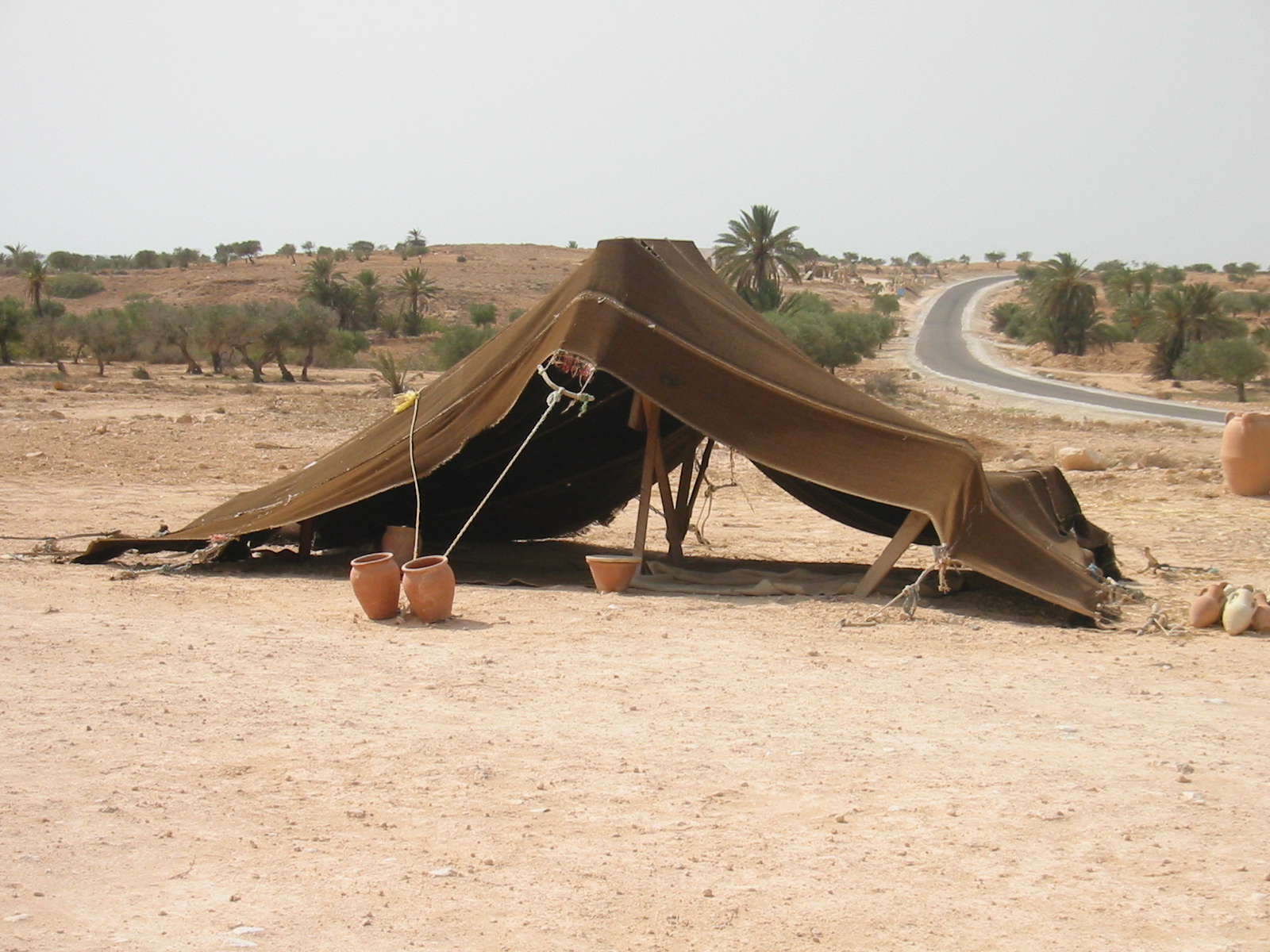
Like many people, this summer my family and I had a holiday which involved camping. One of the joys of camping is sitting outside with a drink watching the world go by, and over the week we saw the campsite constantly changing as people came and went. Some people were staying for two or three weeks, others for a few days and some just for one night. But no matter how long we were staying for, for all of us this was a temporary home. It is possibly this knowledge that made the short trek to the toilet block in the driving rain bearable!
By camping we were all experiencing a little of what a nomadic lifestyle is like, and more so for those who just stopped for the night, a resting place on their journey to somewhere else. For those who choose this way of living it can be a joy, even a release from the materialism and consumerism of society. But for those, such as refugees or the homeless, who have this life forced upon them it can be demoralising and dehumanising.
For the Israelites in the Old Testament the experience of being a nomadic people was deeply ingrained in their identity. They descended from Abraham who left his home in Ur in what is now south eastern Iraq, travelled to Harran, on what is now the southern border of Turkey, and was called by God to leave there to go to 'The Promised Land' of Canaan, now Israel. Abraham's grandson, Jacob, then took his family to Egypt to join his son Joseph, who was by then the Prime Minister of Egypt. The family stayed there and grew in number, were enslaved by the Pharaoh and eventually left Egypt led by Moses. Their re-entry to the Promised Land was delayed because they didn't trust God (Numbers 14) and so their punishment was to wander in the desert for forty years. And even when they were to re-enter the Promised Land, God commanded them “The land must not be sold permanently, because the land is mine and you reside in my land as foreigners and strangers” (Leviticus 25:23).
The wanderings in the wilderness meant that the Israelites got used to living in tents, but the remarkable thing about this is that God chose to join them in their camp. He told Moses “let them make a sanctuary for me, and I will dwell among them” (Exodus 25:8), and then gave instructions on how to build the tent. When it was finished, the glory of the Lord filled it and “In all the travels of the Israelites, whenever the cloud lifted from above the tabernacle, they would set out; but if the cloud did not lift, they did not set out – until the day it lifted” (Exodus 40:36-37). God dwelt with his people to guide them and so they could meet with him.
In describing the coming of Jesus, the gospel writer John says that the “Word became flesh and made his dwelling among us” (John 1:14). The Greek word translated 'made his dwelling' literally means 'encamped' or 'pitched his tent'. In Jesus we see the fulfilment of God's promise to live with and amongst his people and to guide us as we travel through life.
Thursday, 8 August 2019
What does it mean to be human?
Here's my article for the August magazine:


A lot of magazines at
the moment will be giving advice on how to get the perfect
beach-body, although it might be a bit late for this year! We often
have a love-hate relationship with our bodies and both those
attitudes have their down-sides.
On the one hand our
society tends to idolise the body. Body-worshippers, both male and
female, can be found at the gym, in the beauty salons, and strutting
the streets in their designer clothes. Beauty and physical fitness
are seen to be the ideal; we are judged on both and if we fall short
of the standard we are deemed less worthy, less love-able than
others. At its extreme this leads to designer babies and aborting
children with disabilities, but it also shows itself in the social
media pre-occupation with selfies, 'likes' 'ops' and 'rates'.
Idolising the body leads not only to vanity but also to body shaming
and self-esteem issues.
On the other hand there
can be a despising of the body where the 'spirit' of a person is seen
to be the only authentic 'person' and the body is merely a vehicle
for the spirit. In Christian Theology this is known as the heresy of
'Gnosticism' but it is a common belief of Eastern religions such as
Hinduism and Buddhism, and the New Age beliefs inspired by them.
This separation of body and spiritual means that the body can be used
and abused in any way particularly if it will 'enhance' the spirit's
well-being.
Christianity, however,
gets a different perspective on the body from the Bible, and in
particular from its key doctrines of creation, incarnation and
resurrection. The Creation story in Genesis teaches that God made
humans, male and female, as 'ensouled flesh' i.e. as physical bodies
infused with his living spirit. Our bodies are essential to our
being, so much so that God says that he forms us in the womb
(Jeremiah 1:5) and the Psalmist speaks of God knitting and weaving us
in our mothers' wombs so we are wonderfully made (Psalm 139:13-16).
There is no separation between our bodies and our spirits: we are our
bodies as much as we are our spirits.
The incarnation reminds
us that not only did God make us to be flesh and blood, but that in
Jesus he became human, complete with flesh and blood. Another heresy
in the early church said that only Jesus' body was human, while his
mind was divine. However, Jesus was like us in every way, flesh and
blood (Hebrews 2:14,17) and mind too (Hebrews 4:15). Body and spirit
together make up a human being and God affirmed the value of human
beings by becoming one!
The resurrection
accounts of Jesus make it very clear that he was raised physically
and spiritually. Jesus even says to his disciples “Touch me and
see; a ghost does not have flesh and bones, as you see I have”
(Luke 24:39). This tells us that we're not waiting for death to
release our spirits from our bodies but that we're waiting for our
bodies to be renewed to be imperishable, glorious and powerful (1Corinthians 15:42-44). So, whether you're beach-ready or not: love
your body, care for your body and worship the God who created your
body.
Tuesday, 16 July 2019
High School Musical: Same but different
Here's my article for Scawby's June magazine:
I have to admit that the High School Musical phenomenon passed me by.
The 2006 Disney film was a smash hit as soon as it was released and
has spawned sequels, spin-offs and seemingly endless merchandise.
The plot is fairly simple: basketball captain Troy meets academically
gifted Gabriella on a winter holiday. They connect with each other
while singing karaoke, then go their separate ways at the end of the
holiday. Gabriella moves to Troy's school and their friendship is
rekindled as they both try out for parts in their high school's
musical. Their friends want them to concentrate on other things
rather than singing, and the two who usually get the lead roles in
the musicals also try to stop them. Think Romeo and Juliet or Grease
and you'll get the idea.
One
of the themes of HSM is the pressure that Troy and Gabriella face to
conform with their 'tribe'. However, in breaking the stereotypes,
they encourage others to do so too, so there's a basketball player
who likes to bake, a 'nerd' that likes hip-hop, a skater-boy plays
the cello – as one character explains: “people
suddenly think that they can do other stuff; stuff that's not their
stuff”.
The
crucial song is “Stick to the Status Quo”, where those
who try to 'rebel' are told: “Stick to the stuff you know / If you
want to be cool, follow one simple rule / Don't mess with the flow /
Stick to the status quo.” For teenagers especially, the desire to
want to be in a group and blend in is very strong, but the message of
HSM is that it's OK to not conform with the stereotypes, and that
peer pressure to conform can and should be resisted.
In adults this
tribalism can manifest itself in identity politics – people
grouping themselves together on the basis of a single shared
characteristic, often with a claim of victimisation and
discrimination, and often with the aim of getting recognition and
power. Now, of course, seeing someone as of less worth than someone
else because of a characteristic they have is always wrong, but
although it seems a good idea, identity politics has undesirable
consequences. From the point of view of society there is the problem
of the hierarchy of identities: how do we decide which of the
marginalized groups needs to be heard the loudest; what happens if
someone has more than one marginalized characteristic; when does a
marginalized group campaigning for themselves start discriminating
against others? This last question is increasing seen in the way
freedom of speech is stopped whenever the speaker wants to challenge
the assumptions of a marginalized group.
But on a personal level
there is something very worrying about investing so much of your
identity in one characteristic. If you do this you will inevitably
see yourself as being in competition with everyone else, and life
becomes all about dominating others to your advantage. There is only
one characteristic that truly matters: that we are humans beings.
And for Christians that means we have a dignity because we're made in
the image and likeness of God (Genesis 1:26-27). If we identify
ourselves first and foremost as human beings problems of
victimisation and discrimination start to fall away. As the Wildcats
sing at the end “Everyone is special in their own way / We make each other
strong / We're not the same / We're different in a good way /
Together's where we belong / We're all in this together.”
Wednesday, 10 July 2019
Joseph and the problem of identity politics
Here's my article for Broughton's July magazine:
This year's
production by Broughton Primary school is Joseph and the Amazing
Technicolor Dreamcoat. This story is one of the central stories of
the Jewish people, helping to give them their sense of identity. The
most defining story for the Jewish people is the story of the Exodus,
indeed many times God introduces himself by saying “I am the Lord
your God, who brought you out of Egypt” (e.g. Exodus 6:7, Leviticus 26:13, Psalms 81:10). This event is also the basis for their moral
code: the Ten Commandments start with this statement (Exodus 20:2).
But the story of Joseph tells how the Israelites (named after
Joseph's father, Jacob, who was also called Israel (Genesis 32:28))
got to Egypt in the first place.
Foundational
stories are really important for galvanising a group of people
together, and they can also pass on values and valuable lessons to
future generations. Whilst the Exodus speaks of a nation rescued by
God, the story of Joseph shows that favouritism, pride and jealousy
lead to a need to be rescued. Jacob loved Joseph more than his
brothers, which made Joseph vain and lazy, which made his brothers so
angry and envious that they sold him into slavery (Genesis 37). This
seems to have had a profound effect on Joseph who became a diligent
and trustworthy slave, who learnt that the gifts God had given him
were for him to use for everyone's benefit, not just for his own
boasting.
The downside of
national identity is the problem of tribalism. These days tribalism
can manifest itself in identity politics – people grouping
themselves together on the basis of a single shared characteristic,
often with a claim of victimisation and discrimination, and often
with the aim of getting recognition and power. Now, of course,
seeing someone as of less worth than someone else because of a
characteristic they have is always wrong, but although it seems a
good idea, identity politics has undesirable consequences. From the
point of view of society there is the problem of the hierarchy of
identities: how do we decide which of the marginalized groups needs
to be heard the loudest; what happens if someone has more than one
marginalized characteristic; when does a marginalized group
campaigning for themselves start discriminating against others? This
last question is increasing seen in the way freedom of speech is
stopped whenever the speaker wants to challenge the assumptions of a
marginalized group.
But on a personal level
there is something very worrying about investing so much of your
identity in one characteristic. If you do this you will inevitably
see yourself as being in competition with everyone else, and life
becomes all about dominating others to your advantage. There is only
one characteristic that truly matters: that we are humans beings.
And for Christians that means we have a dignity because we're made in
the image and likeness of God (Genesis 1:26-27). If we identify
ourselves first and foremost as human beings the problems of
victimisation and discrimination start to fall away. Add to this a
recognition that we are slaves to our sinful nature and that we can't
save ourselves but need God to rescue us, and you have the start of
the Kingdom of God on earth. And that's a kingdom we should all want to
identify with.
Monday, 3 June 2019
Eternity on our fields
Here's my article for June:
It's time for another World Cup and the singing of “It's coming home” may once again be heard in the pubs and on the playing fields of England - only this year it's cricket that's coming home! Although we possibly shouldn't get our hopes up too much: since it's inauguration in 1975 the ICC Cricket World Cup has been hosted by England four times (though matches have also been played in Wales, Ireland, Scotland and the Netherlands when England have previously hosted it!) but they have yet to win it. However, they have a better record than the England football team in that they have made it to the final three times.

It's time for another World Cup and the singing of “It's coming home” may once again be heard in the pubs and on the playing fields of England - only this year it's cricket that's coming home! Although we possibly shouldn't get our hopes up too much: since it's inauguration in 1975 the ICC Cricket World Cup has been hosted by England four times (though matches have also been played in Wales, Ireland, Scotland and the Netherlands when England have previously hosted it!) but they have yet to win it. However, they have a better record than the England football team in that they have made it to the final three times.

Image by starj on from pixabay.com
I have to admit that I don't really understand cricket. We played it
a bit at school but those who were keen played on the square with the
PE teachers and the rest of us organised mini games on other parts of
the playing field. I usually volunteered to field close to the
boundary so I could lie down in the sunshine for most of the lesson!
The
American director Jim Jarmusch said “Cricket makes no
sense to me. I find it beautiful to watch and I like that they break
for tea. That is very cool, but I don't understand.” Even for those
who don't follow or understand cricket, the game has a certain allure
to it – the thought of an afternoon in the sun watching a game
being played that is competitive but not (usually) aggressive is very
appealing. It has a relaxing and even meditative quality, at least
in watching it.
George
Bernard Shaw, somewhat unkindly, said that “The
English are not a very spiritual people, so they invented cricket to
give them some idea of eternity.” It's fairly easy to make tenuous
links between cricket and the Christian faith: three stumps and the
Trinity (Father, Son and Holy Spirit); four bails and the four
Gospels; two umpires and the Old and New Testaments etc. But the
idea that we can understand something of the supernatural through the
natural world is one that is deeply embedded in Christianity.
We believe that
creation bears the fingerprints of its Creator; Psalm19:1 says “The heavens declare the glory of God; the
skies proclaim the work of his hands.” And Paul writes in Romans1:20 “since the creation of the world God’s invisible qualities –
his eternal power and divine nature – have been clearly seen, being
understood from what has been made, so that people are without
excuse.” But ultimately humans, made in the image and likeness of
God (Genesis 1:27), can reflect something of God through our creative
endeavours, including sport. And because God has put a sense of
eternity into our hearts (Ecclesiastes 3:11) we long to seek out those
things which connect us to that yearning for eternity.
Whether cricket is an
like an eternity of heaven or hell, I'll leave you to decide!
Subscribe to:
Posts (Atom)